
An Air Force Interceptor Said He Heard the Plot Coming. His Supervisor Allegedly Buried It

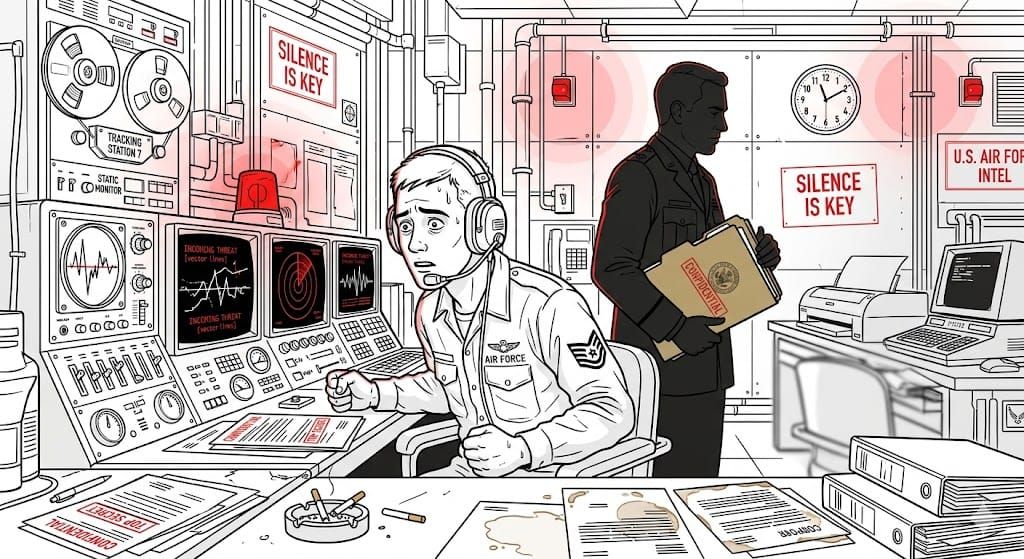
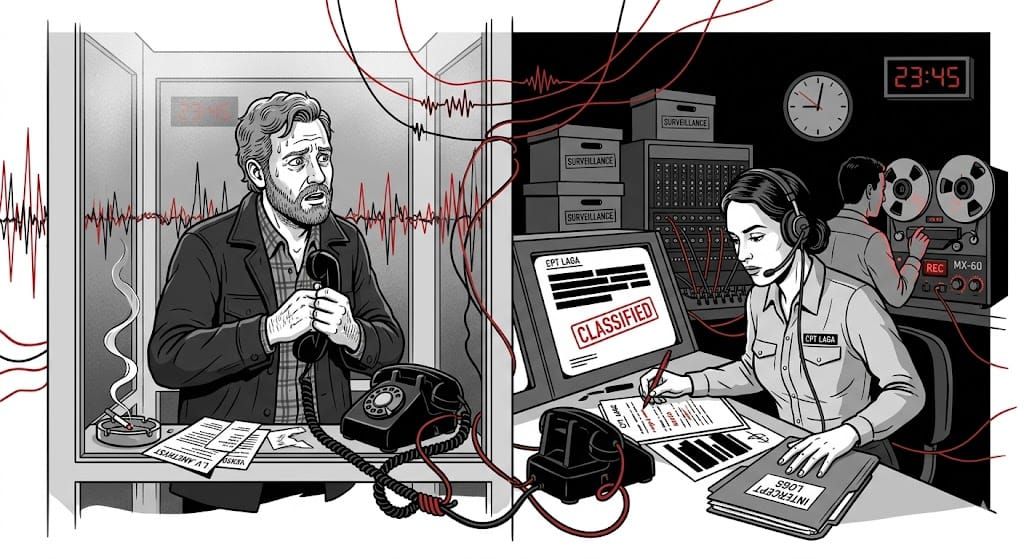
Sometime before November 1963, a U.S. Air Force enlisted man working as a signals interceptor at a listening post in Kirknewton, Scotland picked up a communication. According to his own account, that communication contained information linking a plot to assassinate President John F. Kennedy to a figure in organized crime. He brought the intercept to his supervisor. His supervisor refused to send it to the NSA. The man says that what followed destroyed his life.
His name was David F. Christensen. Fifteen years after the assassination, the House Select Committee on Assassinations was still trying to find out if his story was true. This document is the internal NSA record of what happened when the HSCA went looking for answers.
What the Document Is
Record 144-10001-10185 is a six-page packet classified CONFIDENTIAL and marked "Handle Via COMINT Channels Only." It was produced by the NSA's Legislative Affairs Office in November 1978 and contains two distinct documents: a memorandum for the record written by Eugene F. Yeates, Chief of NSA Legislative Affairs, summarizing a November 8, 1978 meeting with HSCA Chief Counsel G. Robert Blakey; and a formal Memorandum of Understanding between John G. Kester, Special Assistant to the Secretary of Defense, and G. Robert Blakey, governing the terms under which Christensen could be interviewed by the HSCA. A routing slip attached as the final page shows the document was circulated to multiple named individuals within the NSA's Legislative Affairs Office.
The document was reviewed in September 1998 and held at status X, meaning withheld. It was released on November 2, 2017, under the JFK Assassination Records Collection Act.
The Christensen Allegation
The Yeates memo opens by describing the purpose of the November 8 meeting. NSA representative Ed Sapp visited HSCA Chief Counsel Blakey to receive questions about a former Air Force enlisted man's allegation that he had intercepted information linking an assassination plot against President Kennedy to a figure in organized crime. Blakey had been referred to NSA's General Counsel office, specifically to a Dan Silver, by Judy Miller, Special Assistant to John Kester at the Office of the Secretary of Defense.
Paragraph two of the memo lays out what Blakey told the NSA representative about Christensen's background. Christensen had communicated with a friend named Sergeant Michael B. Stevensen, stationed at "Corry" Field in Florida, a reference to Corry Station, the Navy's signals intelligence training facility in Pensacola. By the time of the 1978 meeting, Christensen had been committed to a mental institution, which he attributed, according to Blakey's account, to pressures arising from an incident that occurred in 1963.
Paragraph three is the operational heart of the allegation. At the time of the incident, Christensen was assigned to Kirknewton, Scotland. Kirknewton was a joint U.S. and British signals intelligence facility during the Cold War, operated in coordination with the Government Communications Headquarters of the United Kingdom. The facility was used to intercept Soviet and other communications traffic. Sometime before November 1963, while working as a signals interceptor, Christensen picked up the communications described in paragraph one. The specific nature of those communications is redacted in the released version under exemption b(iii), protecting intelligence sources and methods. What the memo states without redaction is that Christensen's supervisor, identified as Sgt. Prater, refused to forward that traffic to the NSA. Christensen alleges that this refusal, and the consequences of the incident, eventually caused him to suffer a mental breakdown.
Paragraph four records that Blakey stated the NSA had already acknowledged the existence of an interception facility at the Kirknewton location during the relevant period, though Blakey did not indicate to whom that acknowledgment had been made. This detail matters: it means that before this November 8 meeting, the NSA had already confirmed to someone, at some point, that Kirknewton was operational as an intercept facility in late 1963. The agency was not disputing that Christensen could have been doing the kind of work he described.
Blakey's Five Questions
Paragraph five of the memo records the five specific questions Blakey posed to the NSA at the November 8 meeting. Read together, they constitute a precise investigative framework for assessing whether Christensen's allegation was verifiable.
The five questions were:
(a) What is NSA's capability for retrieving communications from this time and place?
(b) How quickly can the retrieval be made? Blakey noted that the HSCA's work was completing in December and that if NSA could answer questions quickly, he would do some preliminary investigation before formally requesting the information. If it would take a long time, he would task the NSA immediately.
(c) What additional information does NSA need from Blakey to speed the retrieval process?
(d) Is the data still available for retrieval at all?
(e) Was Christensen really employed by the Air Force, working for Prater, and actually doing this kind of work at that location during that period?
Question (e) is the foundational verification question. Before any search for the intercept itself could be meaningful, the HSCA needed to confirm that Christensen was who he claimed to be and doing what he said he was doing at Kirknewton in 1963. Blakey wanted that answer by Monday, November 13, giving the NSA a five-day window from the date of the meeting.
The NSA's Internal Response
Paragraph seven of the memo records that on September 7, the NSA's General Counsel had already sent a copy of Christensen's letter to the FBI, along with a letter from the Air Force Security Service to which Sergeant Stevensen had sent the letter. In the General Counsel's letter, he noted that the Security Service was intercepting communications at Kirknewton in 1963 and that links between two redacted entities were monitored. Both the nature of those communications and the identities of the entities being monitored remain redacted in the 2017 release under b(iii).
This is a critical detail. The NSA General Counsel's letter to the FBI, sent months before this November meeting, already acknowledged that Kirknewton was intercepting communications in 1963 and that specific monitored links existed. The NSA was not coming to this question cold in November 1978. The agency had been sitting with knowledge of the Christensen allegation since at least September, had sent it to the FBI, and had confirmed the facility's operational status in the relevant period.
Paragraph eight records that on November 9, the day after the Blakey meeting, Yeates and Ed Sapp met with Dan Silver and decided Silver should respond initially to Blakey's questions by phone. After coordinating with EXEC/DDO, Sapp asked G9 to provide input for a response.
Paragraph nine provides the most concrete piece of investigative action recorded in this document. Harold Parrish of G809 conducted an initial review of data availability from a system designated USA-SS, covering the first eleven months of 1963. From a computer file listing maintained by N3, twenty boxes of data were identified. Cross-checking confirmed this represented all available material. Contents review allowed seventeen of those boxes to be eliminated as nonresponsive. The remaining three boxes were scheduled for manual review on November 13 and were estimated to contain approximately 2,000 sheets per box if they contained relevant traffic at all.
Paragraph ten is the final entry in the Yeates memo and is written partly in handwriting, suggesting it was added after the typed portions were prepared. Yeates notes that he informed Blakey of the news and that Blakey requested the reply be put in writing. Yeates agreed to do so upon receipt of a written request from Blakey. The handwritten addition at the end reads: "and he requested that I put our reply in writing. I agreed to do so upon receipt of a written request from him."
The Memorandum of Understanding
The second document in this packet is a formal Memorandum of Understanding between John G. Kester, Special Assistant to the Secretary of Defense, and G. Robert Blakey, Chief Counsel and Director of the HSCA. Its stated purpose is to govern the protection of classified information from the Department of Defense relating to the HSCA's investigation of Christensen's allegations of Cuban government involvement in the assassination of President Kennedy.
This framing is significant on its own. The subject line of the identification form on page one lists the document's subjects as "Mr. Christensen's Knowledge of Assassination Attempt." But the MOU itself frames the investigation around allegations of Cuban government involvement. Christensen's intercept, whatever it contained, was being evaluated by the HSCA in the context of a broader inquiry into whether Cuba was connected to the Kennedy assassination. The HSCA was not simply verifying a rogue airman's personal claim. It was treating the Christensen allegation as potentially relevant evidence in a conspiracy theory implicating a foreign government.
The MOU's terms establish how tightly controlled the interview process was to be. The Department of Defense committed to making a redacted individual available for interview no later than November 22, 1978, exactly fifteen years to the day after the assassination. The interview was required to take place in secure spaces authorized for discussion of classified signals intelligence information. Its scope was limited to the substantive content of Christensen's allegations, and information dealing with intelligence sources and methods was explicitly excluded from use in responding to questions.
The HSCA's designated interviewer was permitted to make a recording or transcript and to take written notes. However, any notes were subject to inspection by a Department of Defense representative before removal from the interview room, and any classified information in those notes was to be deleted before the notes left the room. If a recording or transcript was made, it remained in DoD possession for classification review. If classified content was found in the recording or transcript, it stayed in DoD possession, with HSCA access available only as needed.
Paragraph six of the MOU explicitly preserves the HSCA's right to issue future subpoenas related to the Christensen allegations, while committing the Committee not to disclose the information until any related litigation had been concluded by judicial action permitting disclosure. This preservation of subpoena rights is a signal that Blakey and the HSCA were not fully satisfied with the terms being offered and were keeping their legal options open.
What Kirknewton Was, and Why It Matters
Kirknewton was a Royal Air Force station in Midlothian, Scotland, about nine miles southwest of Edinburgh. During the Cold War it hosted a joint U.S. and British signals intelligence operation, part of the broader UKUSA signals intelligence alliance that linked the NSA with the British GCHQ and the intelligence agencies of Canada, Australia, and New Zealand. The facility was positioned to intercept communications from Soviet and Eastern European sources, but its collection reach was not limited to those targets.
An interceptor stationed at Kirknewton in 1963 would have been working on sensitive collection tasks, monitoring communications that the U.S. and British governments considered significant enough to warrant signals intelligence coverage. The NSA has confirmed, through the General Counsel's letter referenced in this document, that communications were being intercepted at Kirknewton in 1963 and that specific monitored links existed. The nature of those monitored links remains redacted.
The critical question the HSCA was trying to answer was whether those monitored links in late 1963 included anything that touched on a Kennedy assassination plot connected to organized crime. Christensen said yes, and said his supervisor suppressed the intercept. Whether Sergeant Prater acted alone, whether he was following orders, or whether Christensen's account reflects a genuine suppression of intelligence versus a misremembering or fabrication is precisely what the HSCA was attempting to determine through the interview process the MOU was designed to govern.
The Cuban Government Thread
The MOU's framing of the Christensen inquiry as relating to alleged Cuban government involvement in the assassination deserves specific attention. By November 1978 the HSCA had developed two principal conspiracy theories it was actively investigating: one involving organized crime and one involving Cuban government actors, specifically elements connected to Fidel Castro who might have sought retaliation for CIA assassination plots against him.
The Christensen allegation as described in the Yeates memo links the intercept to organized crime, not directly to the Cuban government. But the MOU frames the broader investigation as being about Cuban involvement. This suggests the HSCA was working on a theory in which organized crime and Cuban government actors were not mutually exclusive categories. The CIA's use of organized crime figures in plots against Castro, which had been publicly revealed through the Church Committee hearings in 1975 and 1976, had established that those two worlds had active operational connections in exactly the period being investigated. An intercept linking an assassination plot to organized crime could, within that analytical framework, also be relevant to a Cuban government thread.
How It Fits the Bigger Picture
Read alongside the previous NSA document in this series, Record 144-10001-10179 completes a picture of the HSCA's signals intelligence investigation in its final weeks of operation. The committee was simultaneously searching the NSA's SIGINT repository for communications connected to Jack Ruby and Cobo Cleaners, and pursuing a separate eyewitness account from an interceptor who claimed to have personally handled a communication that contained advance intelligence about the assassination plot.
Both avenues produced the same institutional friction: the NSA controlled the access, set the terms, and kept classified the specific content that would have allowed the HSCA to fully evaluate the evidence. In the Cobo Cleaners inquiry, the NSA reported that the raw data was destroyed and the product files were incomplete. In the Christensen inquiry, the NSA acknowledged the facility's operational status but wrapped the interview in a Memorandum of Understanding that kept DoD in control of the transcript and authorized the deletion of classified content from any notes the HSCA's interviewer produced.
The HSCA's final report, completed in 1979, did not make definitive findings about the Christensen allegation. The committee's overall conclusion was that Kennedy was probably assassinated as a result of a conspiracy, but the specific evidentiary threads connecting organized crime, Cuban government actors, and potentially suppressed intelligence were never fully resolved. The Christensen allegation is part of that unresolved record.
What this document adds to the record is not a conclusion. It is a window into the mechanics of investigation at the classified level in 1978: an interceptor's unverified claim, an NSA acknowledging that the facility and the collection activity existed, a formal legal agreement governing access to a witness, and a five-day deadline to answer questions that had been sitting unanswered for fifteen years.
The Bottom Line
Record 144-10001-10179 documents one of the most striking individual claims in the entire JFK assassination record: a former Air Force signals interceptor who said he heard the plot coming, reported it to his supervisor, was shut down, and spent years institutionalized as a result. Whether David F. Christensen's account is accurate, exaggerated, or the product of a psychological crisis is not settled by this document. What is settled is that the HSCA took the allegation seriously enough to negotiate a formal legal agreement with the Department of Defense to access a witness, that the NSA confirmed the operational existence of the facility where Christensen said he worked, and that the entire matter was classified at a level that kept it out of public view for nearly forty years.
The intercept Christensen claims he heard, the one his supervisor allegedly suppressed, is still redacted in the 2017 release. Whatever he said he intercepted, someone in the U.S. government decided in 2017 that its specific content still required protection under intelligence source and method exemptions. That decision, made fifty-four years after the assassination, is a fact worth sitting with.
Subscribe to our newsletter
Subscribe to our newsletter to get the latest updates and news






Member discussion