
Army Intelligence Tracks Anti-Castro Recruitment Inside U.S. Military, Three Weeks Before Dallas

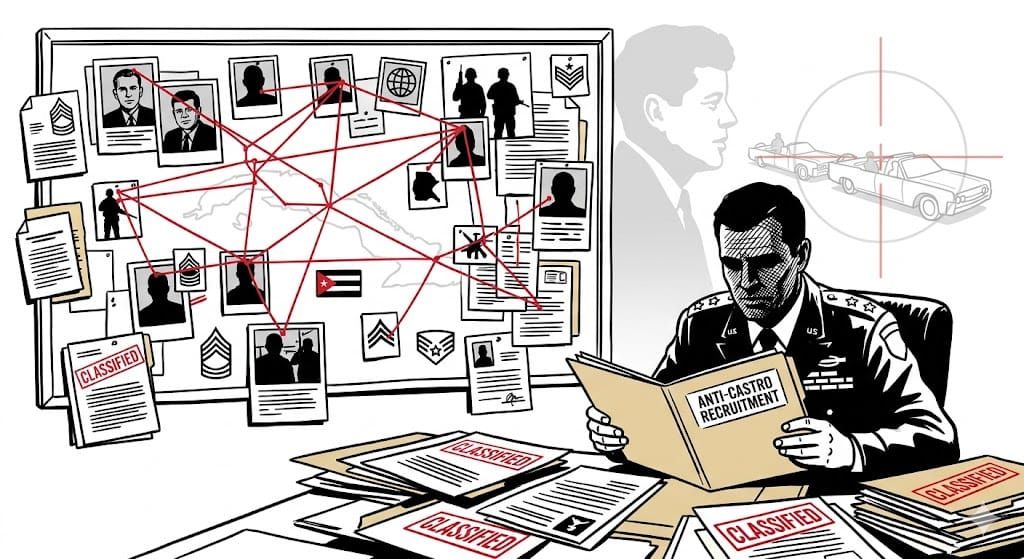
Three weeks before President Kennedy was shot in Dallas, a U.S. Army intelligence unit was quietly documenting something that cut to the heart of the political world surrounding the assassination: an anti-Castro exile leader was actively recruiting Cuban military officers out of American training programs, with the stated goal of building a paramilitary force in Nicaragua to overthrow Fidel Castro.
The man at the center of this report was Manolo Artime. The document that tracked his activities was classified SECRET. It sat in restricted government files for over five decades. This is what it says.
What the Document Is
Record 194-10013-10448 is a six-page SECRET intelligence report titled "Summary of Information" and dated November 1, 1963. It was produced by the D-2 Fourth Army intelligence office, prepared through Region I of the 112th Intelligence Corps Group, based out of San Antonio, Texas. The report falls under the records series designated "DOD-Affiliated Personnel and Incident Investigations," which tells us the Army was monitoring activity among individuals connected to its own training programs.
The document was classified SECRET at the time of its writing, marked with restrictions 1E and 2, and released in 2018 with deletions under JFK Act exemption b(iii). The source identifications are redacted throughout, with the repeated notation "The above information was furnished by [redacted]" appearing after each of the report's ten numbered sections. Each source is rated F-3, meaning the source reliability was "fairly reliable" and the information itself was "possibly true." One item is rated B-3, indicating a more reliable source for that particular section.
Who Manolo Artime Was, and Why It Matters
Manuel "Manolo" Artime Buesa was one of the most prominent figures in the anti-Castro Cuban exile movement. He was a founding member of Brigade 2506, the exile paramilitary force trained and funded by the CIA that launched the failed Bay of Pigs invasion in April 1961. After the invasion collapsed and the Brigade was captured by Castro's forces, Artime was ransomed along with other prisoners in December 1962 as part of the Kennedy administration's prisoner exchange deal.
By 1963, Artime was back in operation. He had the backing of the CIA under a program known as AMBIDDY-1, which authorized him to rebuild an exile military force with U.S. government funding. His plan was to establish training camps in Central America, specifically in Nicaragua with the support of dictator Anastasio Somoza, and to use those camps as a staging ground for renewed paramilitary operations against Cuba. This document shows that part of his recruitment strategy involved pulling Cuban officers directly out of U.S. military training programs.
This is the tension at the core of the document. The United States Army was training Cuban exile officers as part of the Cuban Officer Training Program at Fort Benning, Georgia and Lackland Air Force Base (LAFB) in Texas. At the same time, the CIA was funding Artime to recruit those same officers out of U.S. military programs and into his own private paramilitary operation. The Army's intelligence unit was watching this happen and writing it down.
What the Report Documents, Section by Section
The report opens in June 1963, when Artime traveled to Columbus, Georgia, the city adjacent to Fort Benning, accompanied by Segundo Gorges. His purpose, according to the first source, was to recruit Cuban refugees enrolled in the training program for travel to a "revolutionary camp" in Nicaragua. Artime told a group of officers at a motel meeting that the U.S. government was not going to do anything more for Cuba, and that they needed to look elsewhere for support. He was, in effect, telling American-trained Cuban military personnel that their best path forward was to leave U.S. service and join his privately organized force.
The report identifies by name multiple officers who were present, who resigned from the training program, or who were believed to have departed for Nicaragua after completing their coursework. Among those named: Juan M. Quintana-de la Torre, Mario Eloy Jimenez-Rojo, Armando Caballero-Parodi, Isidro L. Montesino-Acosta, and Pedro Acebo-Rodriguez, the last two of whom resigned from the Cuban Training Program upon completing the Fort Benning course and whose whereabouts were listed as unknown.
By section four, the report describes a broader group of officers at LAFB who were planning to resign after finishing their English language courses. The motive given by multiple sources was consistent: these men intended to transfer to Nicaragua or another overseas location to continue fighting Castro. The document names Rene F. Gomez-Figueroa and the group led by Pedro Acebo-Rodriguez and Antonio Iglesias-Pons as the organizing hub for this resignation campaign.
Section five contains the most geopolitically significant information in the report. According to a source rated S, meaning the information was considered sensitive, Artime had met with Charles de Gaulle of France and Conrad Adenauer of West Germany. Artime reportedly showed these leaders documents and photographs corroborating these meetings, and told at least one Cuban officer that both de Gaulle and Adenauer had promised to help him establish the Nicaraguan camp. This claim, if accurate, placed Artime's operation in contact with two of the most powerful Western leaders of the Cold War era, independent of direct U.S. oversight.
Section seven names Diego Emiliano Borges-Torres as an officer who was actively trying to determine whether the Cuban Officer Training Program's ultimate purpose was identical to Artime's Nicaraguan program. The implication was that some officers suspected the two programs were coordinated, and that once they confirmed this, the entire cohort at LAFB would immediately leave for Nicaragua. The report notes that Somoza of Nicaragua had also promised assistance to Artime, and separately mentions that Artime had offered the Isle of Martinique for operations against Cuba, with de Gaulle of France apparently involved in facilitating that offer.
Section eight identifies the organizational structure of Artime's recruiting network inside LAFB. Diego Emiliano Borges-Torres is named as the chief representative of Artime at the base. Ladislao George Fernandez-Martinez is identified as the second in command. Borges-Torres had made multiple trips to Miami, was spending significant money, and maintained an apartment in San Antonio, Texas. The report notes he was in correspondence with Acebo-Rodriguez and Iglesias-Pons, both of whom had already resigned and were by that point in Nicaragua organizing anti-Castro activities.
Section nine documents a direct recruitment call. Ronaldo N. Blanco-Navarro, a Cuban officer at LAFB, received a telephone call on or about October 25, 1963, from Antonio Iglesias-Pons in Miami. The purpose of the call was to persuade Blanco-Navarro to resign and join Artime's camp in Nicaragua. This is a concrete, dated contact: three and a half weeks before the assassination, a recruiter for an anti-Castro paramilitary operation was calling U.S. military personnel from Miami.
The report closes in section ten with a confirmation that Gomez-Figueroa and Fernandez-Barrios had submitted formal letters of resignation to the Liaison Officer at LAFB on October 28, 1963, four days before this report was written and twenty-five days before the assassination.
What the Redactions Tell Us
Every single source in this document is redacted under JFK Act exemption b(iii), which protects the identities of intelligence sources and methods. This means the Army had a human intelligence network embedded in or adjacent to these Cuban officer training programs in late 1963. Someone inside those programs, or with direct access to them, was reporting to Army intelligence on the activities of Artime's recruiters. The report's coverage is too detailed, too specific in its named individuals and dates, to have come from outside observation alone.
The fact that source identities remain redacted in the 2018 release, more than fifty years later, suggests that either the sources were still living at the time of review, that their identities are connected to other still-sensitive records, or that the standard b(iii) protection was applied broadly without case-by-case reassessment. Any of those possibilities is worth noting.
How It Fits the Bigger Picture
This document does not name Lee Harvey Oswald. It does not contain any direct evidence of a conspiracy to kill President Kennedy. What it does is establish, in precise and contemporaneous detail, the political and paramilitary landscape that surrounded the assassination.
The anti-Castro exile community in 1963 was not a monolithic group. It was a fractured, highly motivated collection of individuals and networks, some working with CIA support, some operating independently, and some actively frustrated with what they perceived as Kennedy's abandonment of the Cuban cause after the Bay of Pigs and especially after the Cuban Missile Crisis, during which Kennedy pledged not to invade Cuba as part of the resolution. Artime's pitch to Cuban officers, documented here, reflects that frustration directly: the U.S. government is not going to do anything for Cuba, he told them. You need to join me.
The HSCA, in its 1979 report, identified anti-Castro exile groups as one of the categories of actors that warranted serious scrutiny in the assassination investigation. The committee found that the CIA-exile operational world was deeply intertwined, that figures like Artime had relationships with CIA officers who were never fully accounted for, and that the intelligence community had not been fully forthcoming in its cooperation with the Warren Commission. This document, produced by Army counterintelligence three weeks before Dallas, is a piece of that world.
It also raises a structural question that investigators have returned to repeatedly: if the U.S. Army's intelligence corps was tracking Artime's recruitment activities inside American military bases in November 1963, what did the CIA know about the same activities, and when? Artime was a CIA asset. His program, AMBIDDY-1, was an active covert operation at the time this report was written. The Army and the CIA were running parallel awareness of overlapping activities, and the degree to which those agencies shared what they knew, before and after the assassination, has never been fully established.
Finally, the international dimension of this document is underreported in most JFK literature. The claim that Artime had met with de Gaulle and Adenauer, and that de Gaulle may have offered the Isle of Martinique as an operations base, places his network in contact with European heads of state at the exact moment the Kennedy administration was navigating some of its most contentious transatlantic relationships. Whether those alleged meetings were substantiated, exaggerated by Artime for recruitment purposes, or genuine is a question this document raises but does not answer.
The Bottom Line
Record 194-10013-10448 is the kind of document that makes the JFK files worth reading. It is not a smoking gun. It is something more useful than that: a contemporaneous intelligence report that places named individuals, named networks, foreign government contacts, and paramilitary planning activity squarely in the three-week window before the assassination. It tells us that U.S. Army counterintelligence was watching this world closely. It tells us that Artime was actively organizing, actively recruiting, and actively citing the inadequacy of American commitment to the anti-Castro cause as his justification.
Reading this document in isolation gives you a window. Reading it alongside the hundreds of other CIA, FBI, and military intelligence records in this collection gives you the fuller picture that investigators have been trying to assemble for sixty years. That is exactly why this series exists.
Subscribe to our newsletter
Subscribe to our newsletter to get the latest updates and news






Member discussion