



members only
The Truth Behind the New York Times Best Seller List
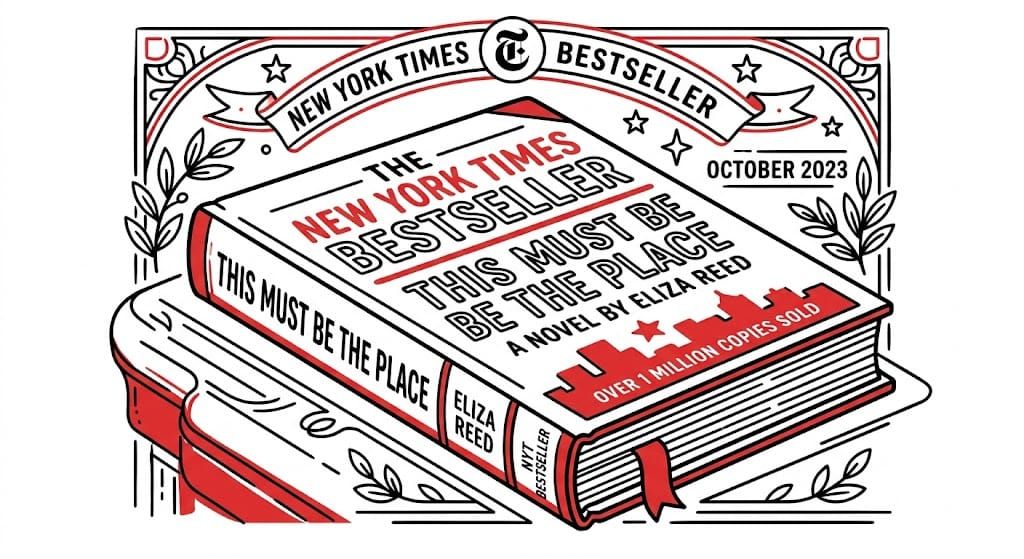
As a short story author and self-published writer on Amazon, I have spent years chasing the dream that quietly drives so many of us in the literary world: signing with a major publisher, seeing my name on a book spine in a real bookstore, and one day landing on the New York Times Best Seller list. That list, in particular, felt like the ultimate confirmation that a writer had arrived, that their work had connected with readers in a meaningful and measurable way.
Then came the contract that changed everything.
A publisher approached me with what seemed, on the surface, like an opportunity. Buried in the fine print was a clause requiring me to pay a "publishing contribution" of $6,200. In other words, I was expected to pay for the privilege of being published. That clause sent me down a research rabbit hole that I have not fully climbed out of since. I started investigating not just the predatory practices of certain publishers, but the broader mythology of traditional publishing itself, including the institution that sits at the very top of that mythology: the New York Times Best Seller list.
What I found was both illuminating and deeply unsettling.
The Mythology We Are Sold
For most readers and writers, the phrase "New York Times Best Seller" carries enormous symbolic weight. It suggests that a book has been embraced by a broad cross-section of the American reading public, that it has risen above the competition on the strength of its quality and appeal, and that the market, acting as a kind of collective judge, has rendered its verdict.
This is the story we are told. It is not, however, the complete story.
The New York Times Best Seller list is one of the most influential cultural institutions in American publishing. A spot on the list can transform a modestly selling book into a cultural phenomenon overnight. It opens doors to media coverage, retail placement, speaking opportunities, and foreign rights deals. For authors, it is the difference between obscurity and visibility. For publishers, it is a marketing asset worth millions of dollars in promotional value.
Given that kind of power, it is worth asking a straightforward question: how exactly does the list work? The answer, it turns out, is far less straightforward than the list's prestige would suggest.
A Methodology Shrouded in Secrecy
The New York Times has never published a full, transparent account of how its best-seller list is compiled. What the public knows comes largely from reporting by journalists, commentary from industry insiders, and the occasional admission buried in the Times' own coverage. The broad outlines are these: the Times claims to track sales data from a wide range of retailers, including independent bookstores, chain bookstores, online retailers, and wholesale distributors. A team of Times editors and analysts reviews this data and produces the weekly rankings.
But the details that would allow independent verification of these rankings remain deliberately opaque. Which specific retailers are surveyed is not disclosed. How much weight is assigned to sales at one retailer versus another is not disclosed. The precise threshold at which a book qualifies for inclusion is not disclosed. And perhaps most significantly, the editorial discretion that the Times reserves for itself in deciding which books to include or exclude is not disclosed.
This opacity is not accidental. The Times has long defended its methodology as proprietary, arguing that full disclosure would make the list easier to manipulate. There is a certain logic to this position, but it also creates a troubling paradox: an institution asking the public to trust its rankings while refusing to explain how those rankings are produced. In any other domain, such opacity would invite serious scrutiny. In publishing, it has largely been accepted as the cost of doing business with one of the industry's most powerful gatekeepers.
How the System Gets Gamed
The secrecy surrounding the list's methodology has not prevented manipulation. If anything, it has encouraged it. Because the criteria for inclusion are partially unknown, publishers and authors have spent decades probing for weaknesses and exploiting whatever they find.
The most documented form of manipulation is the bulk purchase. In this practice, a publisher, an author's organization, a political action committee, or even a well-funded individual purchases thousands of copies of a book in a concentrated burst, typically during the first week of release when sales figures carry the most weight for list consideration. These purchases are designed to mimic the sales patterns of a genuinely popular book, triggering the algorithms and editorial judgments that determine list inclusion.
The Times does attempt to flag books with unusual sales patterns by placing an asterisk next to their titles, with a note indicating that some sales were the result of bulk orders. But this system has significant limitations. The asterisk does not specify how many copies were purchased in bulk, nor does it identify who made the purchases or why. For many readers, the asterisk is either invisible or meaningless. A book labeled a "New York Times Best Seller" retains most of its prestige whether or not a small symbol appears beside its title in fine print.
Beyond bulk purchases, the system is vulnerable to what might be called coordinated retail targeting. Because certain retailers' sales carry more weight in the Times' calculations than others, sophisticated publishers can direct their audiences to purchase from specific outlets, effectively concentrating sales in the channels most likely to influence the rankings. This is a legal and increasingly common practice, discussed openly in some publishing and marketing circles, even if it runs counter to the spirit of what a best-seller list is supposed to measure.
Preorder campaigns add another layer of complexity. Many publishers coordinate large-scale preorder drives, offering bonuses, exclusive content, or other incentives to readers who purchase a book before its release date. Because preorders are often counted toward first-week sales figures, a well-organized preorder campaign can place a book on the list before a single copy has been read by a member of the general public.
High-Profile Controversies That Exposed the Cracks
These are not abstract concerns. Several high-profile controversies have brought the list's vulnerabilities into sharp public focus.
In 2017, a young adult novel called "Handbook for Mortals" debuted at number one on the Times' young adult best-seller list. The placement immediately raised red flags among publishing insiders, who noted that the book had virtually no presence in the retail market and no meaningful cultural footprint among readers in the genre. Investigation revealed that the publisher had made coordinated bulk purchases from retailers whose sales counted toward the list. The Times removed the book from the rankings within days, but the incident revealed how permeable the list's defenses actually are.
That same year, conservative commentator Milo Yiannopoulos publicly claimed that his book had been excluded from the best-seller list despite sales figures that would have qualified it for inclusion. Whether his claim was accurate is difficult to verify independently, but it added fuel to longstanding allegations that the Times applies its editorial discretion in ways that reflect the cultural and political sympathies of its staff. The Times denied the allegations but offered no methodology transparent enough to definitively refute them.
More recently, the 2023 publication of Prince Harry's memoir "Spare" reignited debates about the list's integrity. The book debuted at number one with first-week sales figures that were, by any measure, extraordinary. Critics pointed to the book's massive institutional marketing support, the coordinated retail strategy behind its launch, and the concentration of its sales in specific channels as evidence that its debut was engineered as much as it was earned. Defenders argued that genuine public interest drove the numbers. The truth almost certainly involves elements of both, which is precisely the problem: the list does not allow readers to distinguish between the two.
What the List Actually Measures
It would be unfair and inaccurate to suggest that the New York Times Best Seller list is purely a product of manipulation. Many books that appear on the list are genuinely popular, widely read, and culturally significant. The list is not a complete fiction. But it is also not the objective measure of reader enthusiasm that its prestige implies.
What the list actually measures is a combination of genuine consumer demand, institutional marketing power, retail strategy, and, in some cases, deliberate financial engineering. A book written by a first-time author with a modest publisher and a small marketing budget faces a structurally different path to the list than a book by a celebrity author backed by a major publisher with a seven-figure promotional budget and the capacity to execute a coordinated retail strategy across multiple channels. Both authors might write equally compelling books. Only one of them is playing the same game.
This structural inequality is worth naming clearly, because it shapes the literary landscape in ways that extend beyond any individual book or author. When the list is used as a signal of quality and reader enthusiasm, and when that signal is systematically influenced by resources and strategy rather than merit alone, it distorts how money flows through the publishing industry, which books receive media coverage, which authors are offered subsequent deals, and ultimately which voices get amplified and which remain in the margins.
What This Means for Self-Published Authors
For self-published authors, the implications of all this are worth sitting with carefully. Many of us have internalized the belief that traditional publishing and its associated prestige markers, including the Times list, represent the legitimate path to recognition. Under that belief system, self-publishing is a consolation prize, a fallback for writers who were not good enough or lucky enough to make it through the traditional gatekeepers.
The reality is considerably more complicated. The gatekeepers of traditional publishing are not neutral arbiters of literary quality. They are businesses operating within a competitive market, and the tools they use to signal success, including best-seller lists, reflect the priorities of that market at least as much as they reflect the tastes of ordinary readers.
Self-publishing, for all its genuine difficulties, offers something that the traditional system structurally cannot: direct accountability to readers. When a self-published book sells, the author knows it because a real person chose to spend money on it. There are no bulk purchases, no coordinated retail strategies, no editorial discretions applied by a committee whose criteria are undisclosed. The feedback, whether encouraging or humbling, is real.
That is nothing. In fact, in a landscape where the markers of traditional success are more complicated than they appear, it may be the most honest measure available.
Moving Forward with Open Eyes
None of this is to say that aspiring authors should abandon their dreams of traditional publishing or dismiss the value of wide readership. It is to say that the mythology surrounding institutions like the New York Times Best Seller list deserves honest examination. The list wields real power, and that power shapes real outcomes for real authors. Understanding how it actually works, rather than how it presents itself, is not cynicism. It is a necessary form of literacy for anyone trying to navigate the publishing world seriously.
I came to this understanding through a contract that tried to take $6,200 from me in exchange for a credential I had not earned. The investigation that followed cost me some comfortable illusions. But it also gave me something more valuable: a clearer picture of the terrain I am actually navigating.
Subscribe to our newsletter
Subscribe to our newsletter to get the latest updates and news







Member discussion