
Edgar Hoover's Flying Saucer Problem

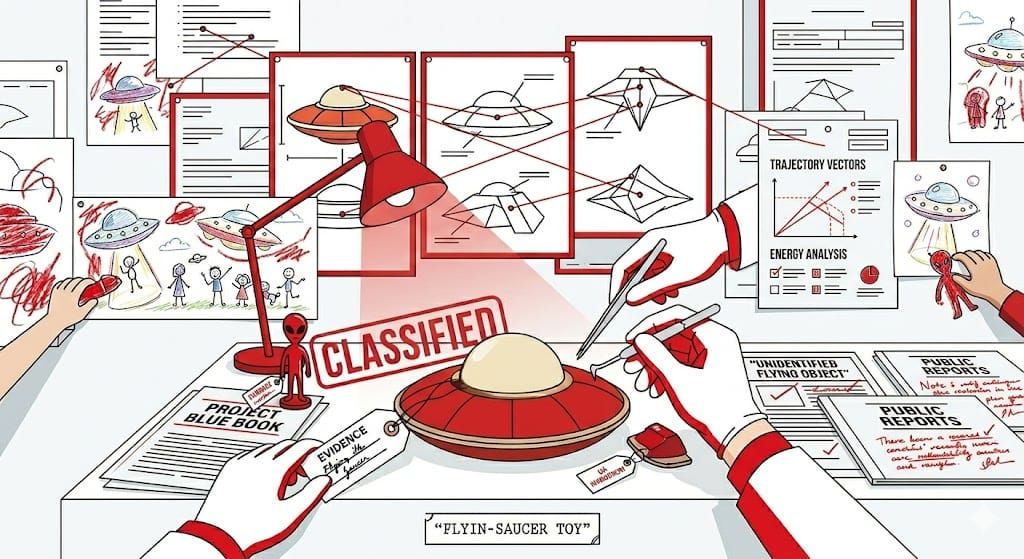
A document-by-document breakdown of 129 pages of declassified flying disc reports, civilian sightings, military intelligence memos, and one very embarrassing kite.
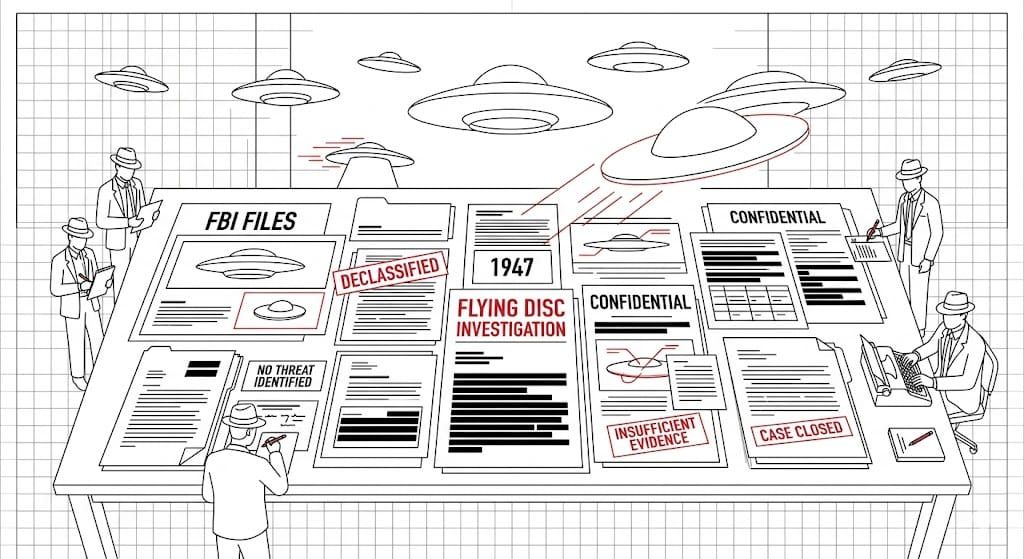
The FBI Vault has been releasing its UFO records for years, and most people skim the headlines without reading the actual files. Part 6 of the 16-part collection is 129 pages of raw, unfiltered bureaucracy from the late 1940s, spanning roughly 1947 to mid-1949. It is not one tidy report. It is a pile of teletype messages, handwritten letters, newspaper clippings, internal memos, and laboratory worksheets, most of them heavily redacted under exemption b7c (which covers third-party personal privacy).
What emerges when you read all of it closely is a portrait of an institution under pressure: J. Edgar Hoover's FBI trying to figure out what exactly it was supposed to do with a phenomenon that the public was obsessed with, the Air Force was officially responsible for, and that kept producing reports that ranged from credible to embarrassing. Here is what the documents actually say.
The FBI's Official Position Was "Not Our Problem" (Until It Was)
The document opens with a bureaucratic tone that sets the stage for everything that follows. Bureau Bulletin No. 57, dated October 1, 1947, is referenced in multiple memos throughout this collection and represents the FBI's foundational stance: flying disc incidents should be referred to the Air Force, and no independent investigative action should be taken by Bureau agents.
A February 20, 1948 letter from the San Francisco office to the Director makes this explicit. The Bureau is conducting no investigations concerning flying discs, the letter states, but will pass along any information that comes to its attention and will receive whatever the Air Forces volunteer. The Headquarters of the Air Forces in Washington is being contacted to ensure there is no misunderstanding about the Bureau's position.
The irony? By the time this letter was written, the FBI had already been dragged into multiple flying disc investigations. The formal policy of non-involvement coexisted with a steady flow of reports arriving at field offices from civilians, local law enforcement, and military personnel, all of whom assumed the FBI was the right place to send them.
The tension between official disengagement and practical entanglement runs through every page of this file.
Project SIGN: The Air Force Was Collecting Soil Samples
One of the most substantive threads in this file involves the Air Force's Project SIGN, the predecessor to the more famous Project Blue Book. Several pages near the end of the document (pages 100-102) show a September 9, 1948, letter from Headquarters, Air Materiel Command at Wright-Patterson Air Force Base to the FBI Laboratory, signed by Colonel W.R. Clingerman, Chief of the Technical Intelligence Division.
The letter requests analysis of a soil sample taken from a depression reportedly caused by a flying saucer described as approximately two feet in diameter and one foot thick. According to the letter, this object supposedly settled gently to the ground, rebounded to a height of about twenty feet, and continued on its journey. The depression was immediately covered by a large washtub, then later filled with rain, which meant the soil sample was compromised before anyone could properly collect it.
The Air Force wanted the FBI Laboratory to determine whether the soil showed traces of unusual elements or alloys, abnormality in structure, or evidence of extreme heat, gases, or radioactive substances. The FBI Lab's October 1948 worksheet (a handwritten document) reports that the sample consisted of various sized pebbles, sand, and dirt. Nothing unusual was noted on the pebbles or in the sand. The structures were normal. No indication of extreme heat. Does not activate Geiger counter on X-ray spectrometer.
In other words: it was just dirt.
The Russians, the Flying Discs, and Guided Missiles
Page 70 contains one of the most striking documents in the entire file. It is a summary of a briefing from a redacted source who had apparently been tracking intelligence reports on Soviet aviation experiments. The document is dense and in many places underlined, suggesting it was considered significant.
The source states that knowledge of a possible disc-type aircraft was not new and that it was known as early as four years prior that some type of flying disc was being experimented with by the Russians. He then cites CIA representatives in Southern Europe and Southern Asia reporting that the Soviets were experimenting with radical aircraft or guided missiles capable of being dispatched for great distances over the sea, made to turn in flight, and return to the base from which they were launched.
What makes this genuinely interesting is what follows. The source describes a peculiar pattern in the reported sightings: from all appearances, the missiles usually approach the United States from a northerly direction and have been reported as returning in a northerly direction. He notes that none have ever been known to crash, collide, or disintegrate over American soil, but that a report was received concerning a collision between one of these missiles and another type of aircraft over Czechoslovakia. According to that report, a Czechoslovaki transport had reportedly collided with some unidentified missile while in mid-air over the ocean, and the missile and transport were completely disintegrated without recovery of parts or survivors from either.
The source concludes by saying that while this is still purely a matter of guesswork, it is nevertheless a source of great concern to the military establishment of this country. He also notes that the Russian experimentation with nuclear energy and their possession of capable German scientists gave them a significant research advantage in developing guided missiles for the propulsion of aircraft.
This memo is not proof of anything extraterrestrial. It reads, in context, as a Cold War intelligence summary treating the disc sightings primarily as a foreign technology concern. But the detail and the tone are unlike the more dismissive reports elsewhere in the file.
The Civilian Reports: What Ordinary People Were Seeing
The bulk of the file is made up of civilian sighting reports routed to the FBI from field offices across the country. They cover 1948 and 1949 and come from Maine, Virginia, Arkansas, California, Texas, and beyond. The reports vary enormously in quality.
The very first page of the collection (May 25, 1949) is a letter from J. Edgar Hoover himself, responding to a civilian correspondent. Hoover thanks her for the information and notes that a correspondent saw a small object in the sky near the end of the day which took various shapes and through glasses appeared like a double bloom trailing something below it. She believed it might be a flying disk. Hoover's note concludes that in view of her nebulous information and as it was very possibly a weather balloon, no further action is deemed necessary.
That summary, nebulous information and probably a weather balloon, recurs in various forms throughout the file. The FBI's institutional response to most civilian sighting reports was to acknowledge, assess briefly, and close.
More detailed is the report involving Wade H. Harrison of Fort Smith, Arkansas, filed April 22, 1949 (page 41). Harrison, employed as a Special Delivery messenger by the Fort Smith Post Office, stopped his automobile at a signal light on the intersection of North Eleventh Street and Grand Avenue at 5:25 p.m. on April 16, 1949, and observed a brilliant object moving in a southeastern direction. He presumed it was approximately two miles high, got out of his automobile, and pointed it out to other drivers stopped for the signal. He watched the object until it was obscured by trees, estimating he tracked it for three or four miles before losing sight. The weather was clear, visibility good, no clouds near the object. The object made no noise perceptible to Harrison.
What adds texture to this report is what happened next. Harrison drove to the 1400 block of North C Street, where he encountered an Army officer standing by his automobile. He asked the officer whether he had observed the flying object. The officer answered negatively but then remarked, "I am glad other people are also reporting seeing flying objects." The officer then told Harrison that the day prior, while traveling from Oklahoma City toward Fort Smith, his wife had observed a flying object similar to the one Harrison described, and that the officer himself had seen it too.
The FBI memo notes this as a corroborating incident but takes no further investigative action.
A Bristol, Virginia newspaper clipping from May 14, 1949 (page 10), carrying the headline "Remember Flying Saucers? Well Looks Like Flying Seegars Now," describes multiple witnesses in the Kingsport, Christiansburg, and Roanoke areas observing long, cigar-shaped objects flashing across the sky. One witness, Rex Rainey of 1805 State Street, reported seeing a whitish, glistening mass, long and cylindrical like a big cigar, flying from east to west at about 7:15. The speed was estimated at approximately 200 miles per hour. A traffic controlman at Tri-Cities Airport said the strange craft had not been seen from the airport but they had fielded inquiries about the cigar-streak. He speculated that the streaks might have been caused by a jet-propelled plane or planes and noted that at 30,000 feet, the vapor trail would be about all a person on the ground could see.
The Hollywood Case: A Flying Disc That Was Actually a Kite
One of the more remarkable threads in Part 6 involves a case file that begins in December 1948 and runs through early 1949. A machinist from Houston, Texas, traveling to Hollywood on business, heard from an acquaintance about what appeared to be a flying disc in a desert area some distance from Hollywood. He organized an expedition that included himself and a couple from South Pasadena, California, and they drove roughly 150 miles northeast of Pasadena, near Lone Pine, California, where they located the object.
The machinist photographed the object using an 8mm movie camera and a speedgraphic camera. He then took three portions of the object back with him. The FBI Houston office sent an urgent teletype to the Director on December 28, 1948 (page 86). The Los Angeles office followed up and arranged to have the three physical parts of the object examined by a manufacturing company. That company positively identified the parts as components of a model tow target constructed by a manufacturer in Los Angeles. The tow target was tested by being towed behind an airplane over an airfield near Helendale, California. The test was a failure, and the target crashed and was abandoned at the airfield.
The full report (pages 55-56) includes interviews with the inventor and his financial backer. The object had originally been developed as a toy kite to be sold in a much smaller model, but the inventor had also developed a larger version that he hoped to sell as a tow target to be used behind airplanes. Against the wishes of the financial backer, who had primarily been interested in the toy market, the inventor built the larger version, took it to the desert for a test, it crashed on its first flight, and he walked away.
The FBI lab worksheet confirms the investigation: the supposed flying disc was returned to the complainant. No further investigation was conducted.
The FBI, the Air Force, and Who Was Actually in Charge
A February 4, 1948 document from the Headquarters, Air Defense Command at Mitchel Air Force Base (page 117) is among the most operationally significant in the file. Marked CONFIDENTIAL and addressed to the Commanding Generals of multiple numbered Air Forces, it lays out explicit protocols for the investigation and reporting of flying disc incidents.
Numbered air forces are responsible for the prompt investigation of incidents within their respective areas. Investigations will be coordinated with the FBI office concerned. Flying discs will be investigated as provided for in Counter Intelligence Incident Cases, taking cognizance of the USAF Operating Intelligence Echelon structure. If it is evident that witnesses were together at the time of incident but widely separated at the time of investigation and would corroborate each other's story, only one witness needs to be interrogated. If there is a reasonable indication that a reported incident is a hoax or the fabrication of a publicity-seeking individual, no further investigative effort will be expended, though a report of such circumstances will be submitted to the FBI office.
This document clarifies something important. The Air Force was not simply collecting UFO reports from civilians. It was running a coordinated counter-intelligence framework with defined roles for the FBI, defined criteria for ending investigations, and explicit guidance on resource management (futile expenditure of military funds and manpower must be avoided).
The FBI's role was, in practice, more subordinate than Hoover's public posture suggested.
The "Flyin-Saucer" Toy: The File's Most Unexpected Document
Pages 20 through 22 contain what may be the strangest enclosure in any federal intelligence file. Somebody, at some point, included the full product insert for "The Amazing Flyin-Saucer," a commercial toy disc manufactured by Pipco Products of San Luis Obispo, California, complete with flight instructions, a diagram for "The Game of Heckle," and the reassurance that this gyroscopic airfoil is Precisely Engineered and Aerodynamically Correct.
The insert is stamped with the FBI file number 62-83874. It was included as an enclosure in what appears to be a report on whether a particular sighting could have involved a toy rather than an unknown aerial object. The game of Heckle requires four players, two on each team, and involves flying the saucer around hecklers positioned at intervals of 18 feet. The first team to score 25 points wins.
This document, bureaucratically filed alongside Soviet guided missile intelligence and Project SIGN soil analysis, is perhaps the clearest illustration of the scope of what the FBI was dealing with: a national obsession that generated everything from serious Cold War threat assessments to promotional materials for plastic toys.
What This File Does Not Contain
It is worth being clear about what Part 6 does not contain. There are no documents describing recovered craft. There are no reports of non-human bodies. There is no reference to Roswell (that case was primarily handled through Army channels and appears in separate files). The famous Hottel Memo, which describes flying saucers with three-foot bodies recovered in New Mexico, is not in this installment.
What Part 6 contains is an organizational paper trail of an institution trying to manage a public phenomenon that fell outside its jurisdiction, assessing civilian credibility, deferring to the Air Force, and occasionally being pulled into field investigations that consistently resolved as weather balloons, tow targets, toy kites, cigar-shaped vapor trails, or simply nothing that could be identified at all.
The documents are fascinating not because they reveal a cover-up, but because they reveal the cover-up of something more mundane: institutional uncertainty, bureaucratic turf wars, and the genuine difficulty of processing a country full of people who were watching the skies and seeing things they could not explain.
This analysis is based on FBI UFO Files Part 6 of 16, available through the FBI Vault at vault.fbi.gov. All page references are to the original 129-page declassified file. Redacted names are indicated by the b7c exemption under the Freedom of Information Act, exempting personal privacy information of third parties.
Subscribe to our newsletter
Subscribe to our newsletter to get the latest updates and news










Member discussion