
The Baron and the Butcher

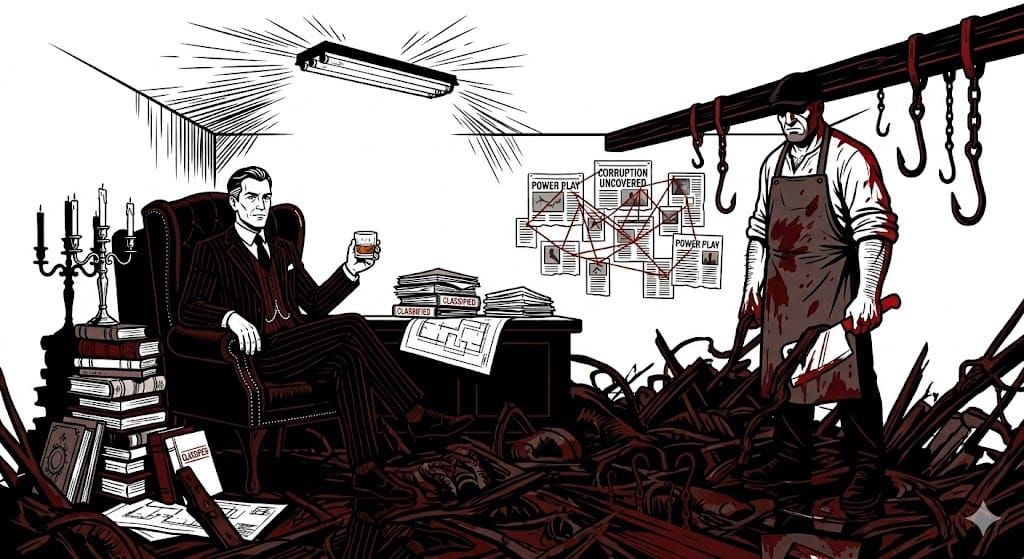
EDITOR'S NOTE
This document is a Verso research file drawn from declassified government records, testimony, and archival journalism. It is intended as a reference and source document for investigative readers. No claims of definitive intelligence agency membership are made where primary source evidence is ambiguous or contested. Where sources conflict, the conflict is noted.
THE MAN
George Sergius de Mohrenschildt was many things simultaneously: a petroleum geologist, a Russian emigre aristocrat, a professor of French at a Texas college, a charming dinner-party fixture in Dallas society, a confidential informant for the CIA's Domestic Contacts Division, and the closest American friend Lee Harvey Oswald had in the months before President Kennedy was shot. He was born on April 17, 1911, in Mozyr, in what was then Tsarist Russia, near the border of present-day Poland, and died by a self-inflicted gunshot wound on March 29, 1977, in Manalapan, Florida, on the same afternoon he was scheduled to give testimony to the House Select Committee on Assassinations.
His biography reads like a Graham Greene novel that has been folded in on itself several times. His father, a Tsarist official and anti-Communist, was imprisoned by the Bolsheviks after the Revolution. The family fled to Poland. George attended a military academy, graduated in 1931, and eventually made his way westward through Belgium and France, earning degrees in commerce and international economics. He arrived in the United States in 1938. By 1944, he was enrolled at the University of Texas, where he earned a degree in geological engineering with a specialization in petroleum geology.
In those same war years, the Office of Strategic Services, the wartime predecessor to the CIA, was already in his orbit. He conducted work that brought him into contact with intelligence networks in Europe, and by the postwar era, his travels as an oil consultant had taken him through Iran, Egypt, Indonesia, Panama, Guatemala, Nicaragua, El Salvador, Nigeria, Ghana, Togo, and Haiti.
In Dallas, he moved in circles that included the city's oil aristocracy: H.L. Hunt, the Richardson family, and the Murchison family. He was well known to CIA officer J. Walton Moore, who ran the Agency's Domestic Contacts Division field office in Dallas from 1948 onward. Their relationship was not incidental. It was structural.
He was not a spy in the cinematic sense. He was the more useful variety: a man with genuine expertise, genuine social access, and a flexible relationship with the truth about who he worked for.
The Warren Commission took his testimony in 1964 and produced hundreds of pages of it, the longest deposition of any witness outside the Oswald family. His wife Jeanne's was nearly as long. Together, they were questioned about their friendship with Oswald, their knowledge of his politics, their social circle, and their sudden departure to Haiti in the spring of 1963. The Commission's handling of that Haitian chapter was, as we will see, deliberately shallow.
Shortly before his death, he began writing a memoir he titled "I Am a Patsy!" The manuscript, delivered to the HSCA by his wife after his suicide, contains the fullest account in his own voice of what he believed, what he did, and what it cost him. It is a document full of bitterness, gallows humor, and occasional startling candor.
HAITI BEFORE DUVALIER
To understand why Haiti mattered to American intelligence in the early 1960s, it is necessary to grasp what Haiti represented geopolitically at the time. The country sits twenty miles from Cuban shores. Its waters and subsoil were long considered promising for oil extraction. And following the Cuban Missile Crisis of 1962, the CIA redirected substantial covert attention from overthrowing Fidel Castro toward monitoring and manipulating the Caribbean governments that could serve as staging grounds for future operations or that might drift toward Castro's orbit.
In the late 1950s and early 1960s, Haiti was the only Caribbean nation to record a decrease in agricultural production. Francois Duvalier, a physician who had built his political career on rural health outreach and nationalist Negritude politics, had come to power in 1957 with some initial American sympathy. He was, in the cold calculus of the era, preferable to a Leftist alternative. His early governance, however, quickly revealed itself as a brutal kleptocracy anchored by the Tonton Macoutes, a paramilitary terror network that operated beyond any institutional constraint.
By the early 1960s, the Kennedy administration had cut U.S. aid to Haiti nearly to nothing, finding Duvalier both repugnant and unreliable. This created a paradox that American intelligence would spend years trying to resolve: Duvalier was intolerable but stable; any replacement was desirable but uncontrollable. Into this paradox walked the protagonist of this article: George de Mohrenschildt.
THE FIRST APPROACHES - LATE 1950S TO 1962
The Northern Haiti Geological Prospect
De Mohrenschildt's interest in Haiti predates the Duvalier era. The HSCA staff report on his activities documents that during an early visit to the country, he conducted a geological prospect for oil drilling in the northern part of Haiti. That initial project was abandoned because of the wave of nationalizations and expropriations sweeping through Caribbean economies at the time.
The failed early venture did not extinguish his interest. When he returned to Haiti in 1961 following his celebrated walking trip through Central America with Jeanne, he immediately resumed negotiations for a new geological engagement. The country's subsoil remained an open question. His professional standing gave him legitimate cover for those conversations. Whether that cover served additional purposes during these early visits remains, in the documentary record, an open question.
Formation of the Haitian Holding Company (1962)
In 1962, de Mohrenschildt formalized his Haitian commercial ambitions by incorporating the Haitian Holding Company. The principals listed were himself, B. Juindine Tardieu, a Port-au-Prince financier with real estate holdings who advised the Banque Commerciale d'Haiti, and Clemard Joseph Charles, the president of that same bank.
Clemard Joseph Charles is the second most important figure in this entire story, and he is almost entirely absent from popular accounts of the Kennedy assassination. He was a serious man: a banker, a liberal nationalist, a figure with genuine reformist ambitions for his country. He was also, by 1963, a CIA asset. And he was George de Mohrenschildt's business partner, social companion, and the person U.S. intelligence had identified as the most viable replacement for Duvalier if and when the regime could be removed.
Charles was a generous and liberal man, a banker who helped people in need without fanfare. He had the interests of the people of Haiti at heart. Had he been able to keep the Americans at bay, he might well have made a decent president of the Republic of Haiti.
The Haitian Holding Company's stated objectives, per de Mohrenschildt's own account, were the development of industries and enterprises in Haiti using Haitian and American resources. The geological survey was its anchor project. But the company also provided the organizational framework within which de Mohrenschildt and Charles could move freely between Port-au-Prince, Dallas, New York, and Washington, meeting with oil company executives, government officials, and intelligence officers.
THE CONTRACT - MARCH TO JUNE 1963
The Oswald Connection and the Haitian Reward
The most explosive element of de Mohrenschildt's Haiti chapter is its timing relative to his handling of Lee Harvey Oswald. De Mohrenschildt befriended Oswald in the summer of 1962, shortly after Oswald returned from his defection to the Soviet Union. He and Jeanne became the Oswalds' most consistent social connection in Dallas and Fort Worth, a relationship that was asymmetrical, condescending on de Mohrenschildt's side, and apparently genuine on Oswald's.
In his final interviews with author Edward Jay Epstein, conducted just days before his death, de Mohrenschildt made the most direct statement of his life about the nature of that relationship. He said that J. Walton Moore, the CIA's Dallas field officer, had asked him to find out about Oswald's time in the Soviet Union. In return, he said, he was given assistance with an oil deal he was negotiating with Duvalier. In March 1963, de Mohrenschildt received the contract from the Haitian government. He believed, he said, that this was because of the help he had given to the CIA.
Source: Edward Jay Epstein interview notes, March 1977; Spartacus Educational, George de Mohrenschildt entry; HSCA Vol. XII staff report.
The CIA's continued operational interest in de Mohrenschildt as he prepared to leave for Haiti is documented in its own files. A CIA Office of Security record declassified in 1976 shows that on April 29, 1963, a Case Officer had requested an expedite check on George de Mohrenschildt for reasons noted as unknown to the security division. This is not the record of an agency cutting ties with a peripheral contact. This is the record of an agency maintaining active surveillance of an asset in motion.
The contract itself was a $250,000 geological survey agreement, signed by President Duvalier personally, and published in the H'aitian Congressional Record. By April 1963, as de Mohrenschildt later described in "I Am a Patsy!," all their belongings were packed, and he was ready to leave. His last significant act in Dallas was a final visit to the Oswalds on Easter Sunday, 1963. He never saw Lee Harvey Oswald again.
In June 1963, George and Jeanne de Mohrenschildt moved to Port-au-Prince.
HAITI - THE DOUBLE GAME
The Survey, the Sisal, and the Cover
Once established in Haiti, de Mohrenschildt presented himself publicly as what his contract described him as: a geological surveyor and industrial developer. He and Jeanne resided in Tonton Lyle Estates, a mountainous residential development situated directly adjacent to the presidential palace. That proximity, which de Mohrenschildt himself later noted with dark irony, would become one of Duvalier's many sources of paranoia about him.
He described himself, in his memoir, as a farmer. He employed thousands of Haitians on a kenaf plantation, a cash crop fiber plant used in paper production. The agricultural operation was real. The geological survey work was real. And yet the record documents that neither enterprise was the totality of what he was doing in Haiti during those four years.
The Regime-Change Operation: Charles, Matlack, and Army Intelligence
In May 1963, before he had even relocated to Port-au-Prince, de Mohrenschildt arranged a meeting between Clemard Joseph Charles and Dorothy Matlack, an officer in U.S. Army Intelligence. An Army Intelligence memo subsequently noted that de Mohrenschildt and Charles had traveled together in 1963 to meet various U.S. government officers in both Washington and New York. The memo described de Mohrenschildt as having close personal contacts that enabled Charlesto air his views and intentions to the higher echelons of U.S. intelligence and government. On occasions, the memo noted, it was either de Mohrenschildt or Charles who made direct telephone contact with U.S. intelligence, rather than the reverse.
This is a critical detail. Contact running in both directions, with the asset initiating at least as often as the handler, indicates a relationship that had matured beyond passive informant work into something more structured and proactive.
Matlack and a colleague concluded from their meetings that the U.S. should continue to play ball with Charles because, if Duvalier could be removed, Charles's cousin was positioned to take power. Haiti's geographic proximity to Cuba, twenty miles of water, made this regime-change calculus directly relevant to the broader Caribbean strategy.
The Herbert Atkin Allegation: Philip Harbin
The most direct allegation about de Mohrenschildt's operational function in Haiti comes from Herbert Atkin, an ex-CIA contract employee who later worked for an oil company in Los Angeles. Atkin stated, after de Mohrenschildt's 1977 suicide, that he had known de Mohrenschildt under the alias Philip Harbin. Atkin was prepared to testify, he said, that de Mohrenschildt was the overseer of an aborted CIA plot to overthrow Duvalier, planned for June 1963.
The Church Committee examined the existence of this plot but was unable to substantiate it on the available record. The absence of documentary confirmation does not resolve the question. It simply means the paper trail, if one existed, remained classified or was destroyed. Atkin's account was never formally tested under oath.
The Double Display: Playing Both Sides at the Dinner Table
A CIA memorandum from the Haiti station records a social observation that crystallizes de Mohrenschildt's position in Port-au-Prince: at one of his Haitian house parties, he was observed displaying a Casimir painting adorned with Duvalier political slogans while simultaneously talking up the regime to his guests. Casimir paintings are a tradition in Haitian naive art, often featuring political imagery. A man hosting parties near the presidential palace, hanging Duvalier iconography on his walls, while privately facilitating meetings between Duvalier's banker-enemy and U.S. Army Intelligence officers, was playing at least a double game. As the AARC analysis of these records noted, it may have been a triple game.
THE NETWORK - KEY FIGURES
- J. Walton Moore - CIA Domestic Contacts Division, Dallas
Moore was de Mohrenschildt's principal CIA contact throughout the Dallas years and, based on de Mohrenschildt's own final statement, the man who tasked him with monitoring Oswald. The HSCA confirmed that Moore was employed by the CIA's Domestic Contacts Division in Dallas from 1948 and that his association with de Mohrenschildt was documented. The Warren Commission was aware of this association and did not pursue it with any rigor.
- Clemard Joseph Charles - Banque Commerciale d'Haïti
Charles was the president of Haiti's first independent commercial bank and a man of genuine political ambition. He was recruited by the CIA in 1963, the same year the agency was funding exile and rebel groups attempting to remove Duvalier. He traveled to the United States with de Mohrenschildt and met with U.S. intelligence officials. He was eventually caught by Duvalier. He was imprisoned twice in Fort Dimanche, the most brutal detention facility in Haiti, stripped of all his assets, including foreign bank accounts. The CIA did not intervene to help him. Joan Mellen's 2012 research documents the parallel abandonment of Charles and de Mohrenschildt as a structural pattern in how the agency treated its Haitian assets once the political situation shifted.
- Isadore Irving (I.I.) Davidson - Arms Dealer, CIA Asset, Duvalier Lobbyist
Davidson was a Washington-based lobbyist and licensed arms dealer who represented a remarkable constellation of clients across the Cold War's dirtiest theaters: Anastasio Somoza's Nicaragua, Papa Doc Duvalier's Haiti, Clint Murchison's Dallas oil operation. In 1964, Duvalier hired Davidson to represent the Haitian government in Washington. While in Haiti, Davidson encountered de Mohrenschildt. Classified documents subsequently revealed that Davidson was providing information to U.S. intelligence services during this period, functioning, in Joan Mellen's framing, as the agency's watch on all the other players, de Mohrenschildt, Charles, and Duvalier simultaneously. His alleged social network also encompassed J. Edgar Hoover, Jimmy Hoffa, Carlos Marcello, and Santos Trafficante.
- Dorothy Matlack - U.S. Army Intelligence
Matlack was the Army Intelligence officer who met with de Mohrenschildt and Charles in May 1963, before the Haiti relocation. Her assessment that the U.S. should play ball with Charles as a Duvalier replacement candidate was the clearest official endorsement of the regime-change track. Her meeting with the pair represents the documented intersection of de Mohrenschildt's Haiti operation with formal military intelligence planning.
- The T-28 Affair: Sydney Schine and Henry Kleplak
A 30-page April 1965 memo from James Angleton, the CIA's chief of counterintelligence, to the Director of the FBI introduces yet another layer. The memo documents that de Mohrenschildt and Charles were involved in a deal to enable Duvalier to obtain T-28 trainer aircraft, a propeller-driven military plane that could be converted for combat use, from Dallas sources, through intermediaries Sydney Schine and Henry Kleplak. The U.S. government blocked the transaction. When Jeanne de Mohrenschildt was asked about this by a CIA contact, she responded with characteristic directness: 'Why not let the Haitians buy a few planes? They will not be able to do anything with them.' The attempt to arm Duvalier, coming alongside the simultaneous effort to facilitate his removal, exemplifies the incoherence at the center of American Haiti policy in this period.
THE COLLAPSE - KENNEDY, THE WARREN COMMISSION, AND THE END OF THE CONTRACT
On November 22, 1963, George and Jeanne de Mohrenschildt were in Port-au-Prince, attending a reception at the Lebanese Embassy, when someone entered and announced that a president had been shot. De Mohrenschildt, in "I Am a Patsy!" writes that his first thought was of Duvalier, his nominal boss. When told it was Kennedy, and that it had happened in Dallas, he drove directly to the American Embassy. His comment, recorded in his memoir and delivered with the bitter timing of a man who had spent years in the world's most surveilled city:
"If he had his tontons macoutes around, this would not have happened."
Within hours, his world in Haiti began to collapse.
News of his Warren Commission summons reached Duvalier through the palace's informant network before de Mohrenschildt himself could manage the information. Papa Doc, whose pathological fear of assassination was the defining feature of his political psychology, immediately recontextualized his American contractor. A man living next door to the presidential palace, who was friendly with the accused assassin of a sitting president, was not a geologist. He was a threat.
In his own Warren Commission testimony, de Mohrenschildt described the situation directly: Duvalier held a contract with him and had gotten wind he was called by the Warren Committee. Nobody knew how it happened. And now Duvalier associated him, being very scared of assassination, with a staff of international assassins. He was about to be expelled from the country. His contract was on the verge of being broken.
American diplomatic intervention temporarily salvaged the situation. The Haitian Ambassador in Washington was reassured by the Warren Commission that the de Mohrenschildts were decent people and transmitted this message to Duvalier. They were permitted to return to Haiti after testifying. But something irreversible had shifted. Duvalier now knew, as de Mohrenschildt wrote with the sourness of experience, that the American Embassy would no longer protect his rights. The payments for the survey began drying up. No one at the Embassy or the State Department would assist him in recovering the substantial balance still owed under the contract.
He had been useful. He was no longer useful. The apparatus that had helped him obtain the contract had no interest in helping him collect on it.
'The old fox was absolutely right,' de Mohrenschildt wrote of Duvalier. 'The payments for my survey began drying up, and in later years I never received any cooperation from anyone in our Embassy or in the State Department in trying to recover the large balance of my contract still due to me.'
The Warren Commission counsel's parting words to de Mohrenschildt, as recorded in his memoir, have the quality of a dismissal: You did all right. Keep up the life you have been leading. You helped a poor family. And then, as a quiet aside: Remember, sometimes it is dangerous to be too generous with your time and help.
THE DEPARTURE AND THE LONG AFTERMATH (1967-1977)
The de Mohrenschildts left Haiti in 1967, ending four years on the island. The geological survey contract had effectively been abandoned. The Haitian Holding Company's industrial ambitions had produced a sisal and kenaf farming operation that employed Haitians but yielded no significant profit. Clemard Joseph Charles, by this point, had been exposed by Duvalier, imprisoned in Fort Dimanche, and stripped of his assets. The regime-change operation, if one had ever been formally authorized, had produced nothing.
The broader paramilitary efforts against Duvalier continued through 1968, culminating in a significant failed expedition that included a Super Constellation aircraft bombing the National Palace. De Mohrenschildt had no documented role in that final operation. He was by then back in Dallas, increasingly erratic, cycling through financial difficulties, mental health crises, and the slow-building pressure of investigators who would not leave his past alone.
He was hospitalized. He lectured. He took academic positions in Africa and the Caribbean. He wrote. He was approached by Dutch journalist Willem Oltmans, who had been led to him by a European clairvoyant claiming to have visions of Kennedy's conspirators; de Mohrenschildt found this absurd and ultimately agreed to be taken to Belgium by Oltmans anyway, in early 1977, in circumstances that remain contested.
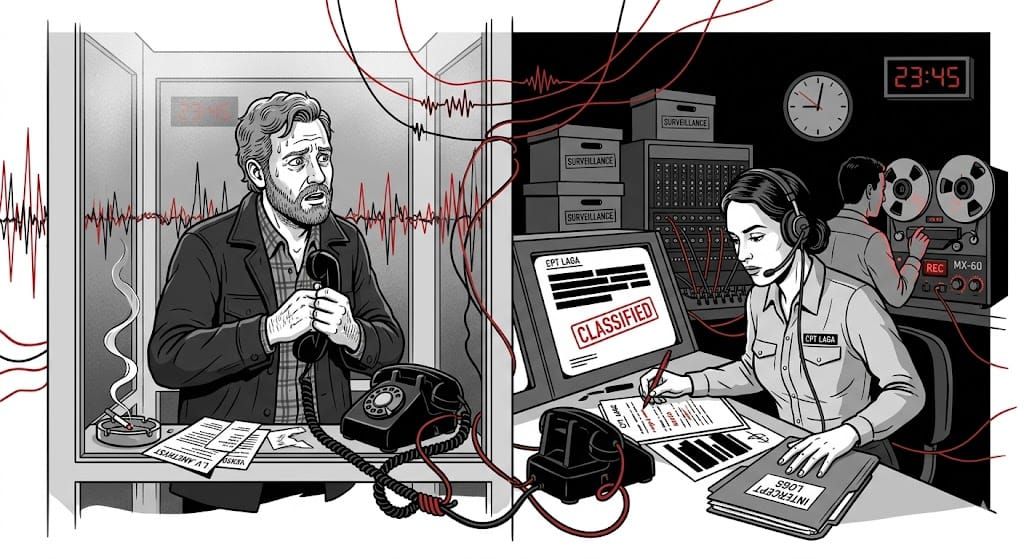
The House Select Committee on Assassinations reopened its investigation in the mid-1970s and sought his testimony again. On March 28, 1977, the committee served him with a subpoena. On March 29, 1977, at approximately 3:45 in the afternoon, George de Mohrenschildt placed a shotgun in his mouth and pulled the trigger. A tape recorder he had left running to record afternoon soap operas for his absent host established the precise time. There were no witnesses.
He was 65 years old. He had spent the morning, hours before his death, speaking with Edward Jay Epstein, the author who recorded his admission about monitoring Oswald at J. Walton Moore's request, and about the Haiti contract as his understanding of compensation.
Joe Dryer, another figure from the Haiti network who had known de Mohrenschildt in Port-au-Prince and had never particularly liked him, made contact with de Mohrenschildt the day before his death. The coincidences surrounding the timing of his suicide have been noted, disputed, and never resolved.
WHAT THE RECORD SHOWS AND WHAT IT DOES NOT
The evidentiary picture of de Mohrenschildt's relationship with Haiti and with Duvalier supports several firm conclusions, several strong inferences, and a residue of unresolved questions that the declassified record cannot close.
- What is documented
De Mohrenschildt had a genuine and longstanding professional interest in Haiti's geological potential, predating the Duvalier era. He formed the Haitian Holding Company with Clemard Joseph Charles in 1962. He obtained a $250,000 geological survey contract with the Haitian government in March 1963, signed by Duvalier. He moved to Haiti in June 1963, the same month he last saw Lee Harvey Oswald. He was in active contact with U.S. intelligence through J. Walton Moore during the period immediately preceding and including his move to Haiti. He facilitated meetings between Charles and U.S. Army Intelligence officers. He was under CIA surveillance while in Haiti, documented in a memo chain involving James Angleton and the FBI. The CIA was aware of the T-28 airplane deal and blocked it. His contract payments ceased after the Warren Commission summons became known to Duvalier. He admitted, in his final interviews, that the Haitian contract was his understood compensation for CIA-assigned surveillance of Oswald.
- What is strongly inferred but not definitively proven
The facilitation of the Haiti contract by J. Walton Moore was a formal quid pro quo arrangement rather than an informal favor. That de Mohrenschildt's operational function in Haiti included support for a CIA-sponsored effort to replace Duvalier with Charles. That his residence near the presidential palace was not coincidental.
- What remains contested or unresolved
Whether Herbert Atkin's claim that de Mohrenschildt operated under the alias Philip Harbin and supervised a June 1963 coup plot is accurate. Whether de Mohrenschildt's 1977 death was a suicide or an assisted death timed to prevent his HSCA testimony. Whether the full documentary record of his CIA relationship has ever been made available.
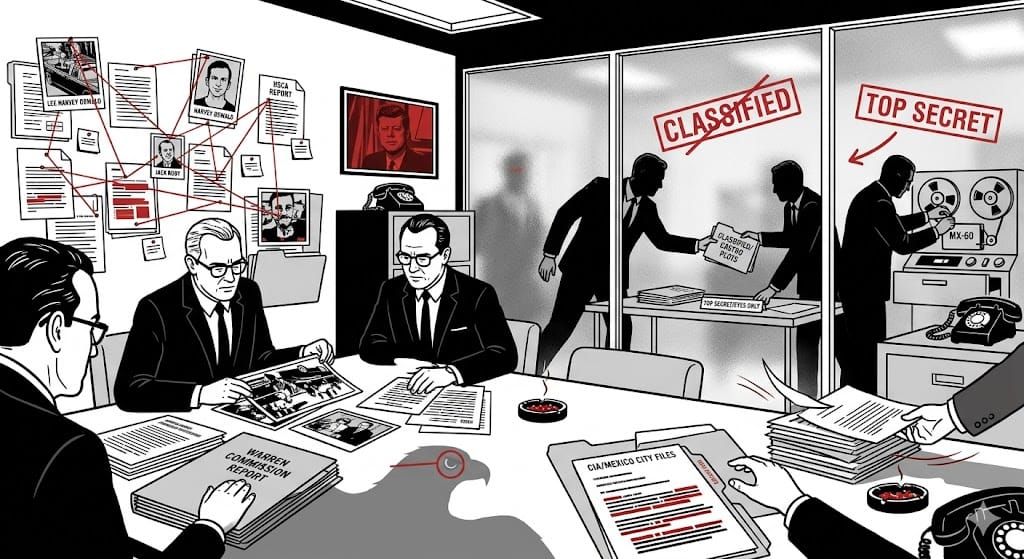
The Church Committee examined these questions and could not substantiate the coup plot allegation. The HSCA drew no definitive conclusion about his intelligence status beyond confirming the Moore relationship and the surveillance records. The Warren Commission, as de Mohrenschildt himself noted with bitterness, produced hundreds of pages about his personal life and essentially nothing about the structural context of why an oil geologist with a CIA case officer had just moved next door to the presidential palace in Port-au-Prince.
The Warren Commission produced hundreds of pages about his dinner parties and essentially nothing about who paid for the contract that sent him to Haiti in the first place.
PRIMARY SOURCES AND FURTHER READING
- George de Mohrenschildt, I Am a Patsy! I Am a Patsy! (manuscript, 1977). Available in edited form with introduction and notes by Michael Rinella. Full text available at 22november1963.org.uk.
- Warren Commission Testimony, George S. de Mohrenschildt, Volume IX. Available at history-matters.com.
- HSCA Vol. XII: Staff Report on George de Mohrenschildt. Available at aarclibrary.org and history-matters.com.
- https://history-matters.com/archive/jfk/hsca/reportvols/vol12/pdf/HSCA_Vol12_deMohren.pdf
HSCA Appendix to Hearings - Volume XII


- CIA CREST / ARRB documents cited: 104-10431-10039 (Angleton to FBI, April 1965); 104-10431-10035 (DEMOHRENSCHILDT draft biography, 1964); CIA Office of Security file, April 29, 1963, expedite check request.
- Joan Mellen, Our Man in Haiti - print only, no free full text online. Publisher page: https://www.trineday.com/product/our-man-in-haiti/
- Spartacus Educational, George de Mohrenschildt entry: https://spartacus-educational.com/JFKdemohrenschildt.htm
- Bill Simpich, The Twelve Who Built the Oswald Legend, Part 8 — AARC: https://aarclibrary.org/2018/01/27/the-jfk-case-the-twelve-who-built-the-oswald-legend-part-8-the-cia-army-intelligence-mambo/
- Spartacus Educational, Isaac Irving Davidson entry: https://spartacus-educational.com/JFKdavidsonI.htm
SPONSORED
No paywall. No algorithm. Just the work. If you want to chip in, here's the jar.
Subscribe to our newsletter
Subscribe to our newsletter to get the latest updates and news







Member discussion