
The Bureau’s Paper Shield

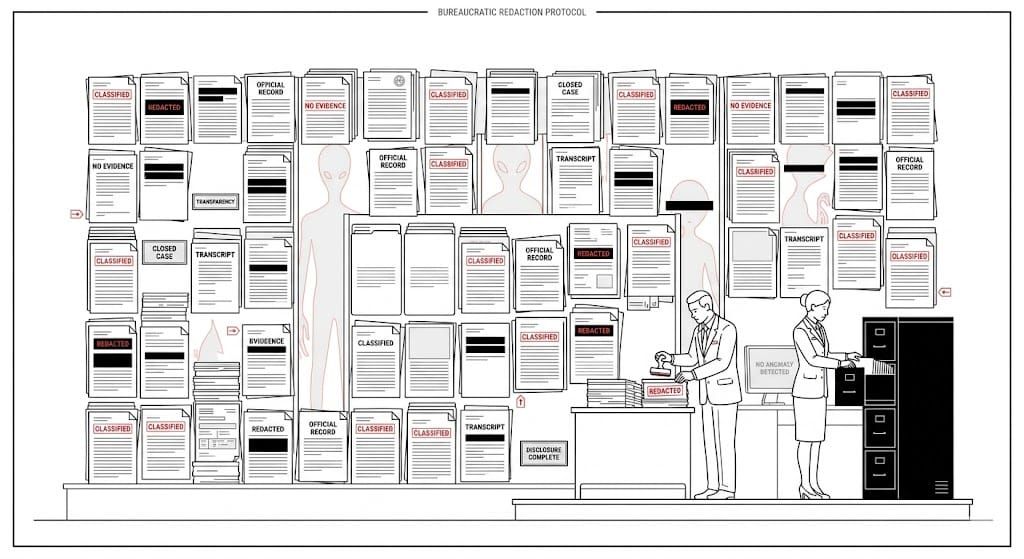
This 111-page dossier is a disorganized collection of field reports, internal FBI memoranda, teletype cables, and witness affidavits dating primarily from July to September 1947. It represents the initial bureaucratic scramble to catalog what the documents call "flying discs" or "flying saucers". This matters because it reveals a massive disconnect between field agents who take reports seriously and a high-level "topside" that was either completely oblivious or, more likely, engaged in a tactical retreat from the truth.
The Core: Key Players and Testimony
- Kenneth Arnold (The Catalyst): The June 26, 1947, report of nine objects over the Cascades is the baseline. The FBI spent considerable time interviewing secondary witnesses to verify Arnold’s credibility, rather than just investigating the objects themselves.
- The Statesman Pilot: An unnamed pilot for the "Idaho Daily Statesman" filed a sworn statement about a July 9 sighting near Boise. He describes a black, round object performing "erratic" maneuvers. He even tried to film it on eight-millimeter film, but the lab claimed the object was too distant to register.
- Military Casualties: Capt. Davidson and Lt. Brown, AAF investigators, were killed in a B-25 crash at Kelso, Washington, on August 1, 1947. They were reportedly carrying "disc fragments" from a separate incident at Maury Island.
- The Maury Island "Hoax": The investigation suggests individuals named Dahl and Crisman admitted the Maury Island "fragments" were a hoax designed to sell slag. However, the timing of the "confession" and the subsequent fatal crash of the investigators creates a massive narrative gap.
Sectional Breakdown: Bureaucracy vs. Reality
1. The Witness Vetting (Pages 1 through 9) The FBI focused on "reliable members of the community" like United Airlines pilots and military veterans. The logic was simple: these men had too much to lose by lying. They describe metallic, circular objects traveling at speeds estimated up to 6000 miles per hour.
2. The Martian Intercept (Pages 10 through 13) A coded message appearing in a Long Island newspaper ("Newsday") claimed Martians would set up a "world order" late in 1947. The FBI Laboratory spent actual resources decoding this, only to dismiss it as the work of a "screwball". It is a distraction in the file that highlights how the Bureau was drowning in noise.
3. The "Bird-Dog" Memo (Page 24) D.M. Ladd’s August 8 memo is the legal pivot. He argues the FBI should stop "playing bird-dog for the Army" and quit wasting "precious manpower" on complaints that have no connection to Russian espionage. He essentially tries to wash the Bureau’s hands of the entire phenomenon.
4. The Topside Vacuum (Pages 25 through 26) This is the most damning section. Internal notes indicate that while Sweden was seeing "ghost rockets," the U.S. "high brass" appeared "totally unconcerned" about domestic sightings. This lack of concern led some agents to believe the government already knew exactly what the objects were.
Red Flags and Black Holes
- The "Soapstone" Excuse: Multiple pieces of physical evidence submitted by the public were identified by the FBI Lab as "powdered soapstone" or "ordinary sand". There is a suspicious pattern of the Bureau returning "unused portions" of junk while ignoring the data from trained observers.
- Maury Island Inconsistencies: The file leans heavily on the "hoax" theory for Maury Island, yet it also contains frantic teletypes about the death of the AAF investigators who were on that specific case. If it was just slag, why did the plane go down?
- Missing Film: The Boise pilot’s 8mm film showed "no trace" of the object according to the Eastman Laboratories. In an investigation of this scale, the absence of a "chain of custody" for such media is a glaring hole.
Next Steps and Implications
We at Verso believe this document proves the FBI was never looking for "Martians." They were looking for an excuse to stop looking. The investigation should now pivot to the "high brass" mentioned in the August 19 memo. If the military was "totally unconcerned," it implies they were either in control of the craft or had already secured the wreckage.
The next move for the investigation is to subpoena the internal records of the "Research and Development Section of the Air Forces," specifically mentioned on page 28. We need to know what General LeMay’s office actually replied to General McDonald. The Bureau might have been playing bird-dog, but the Air Force was holding the leash.
Access file: here
Subscribe to our newsletter
Subscribe to our newsletter to get the latest updates and news











Member discussion