
The Face We Gave Them

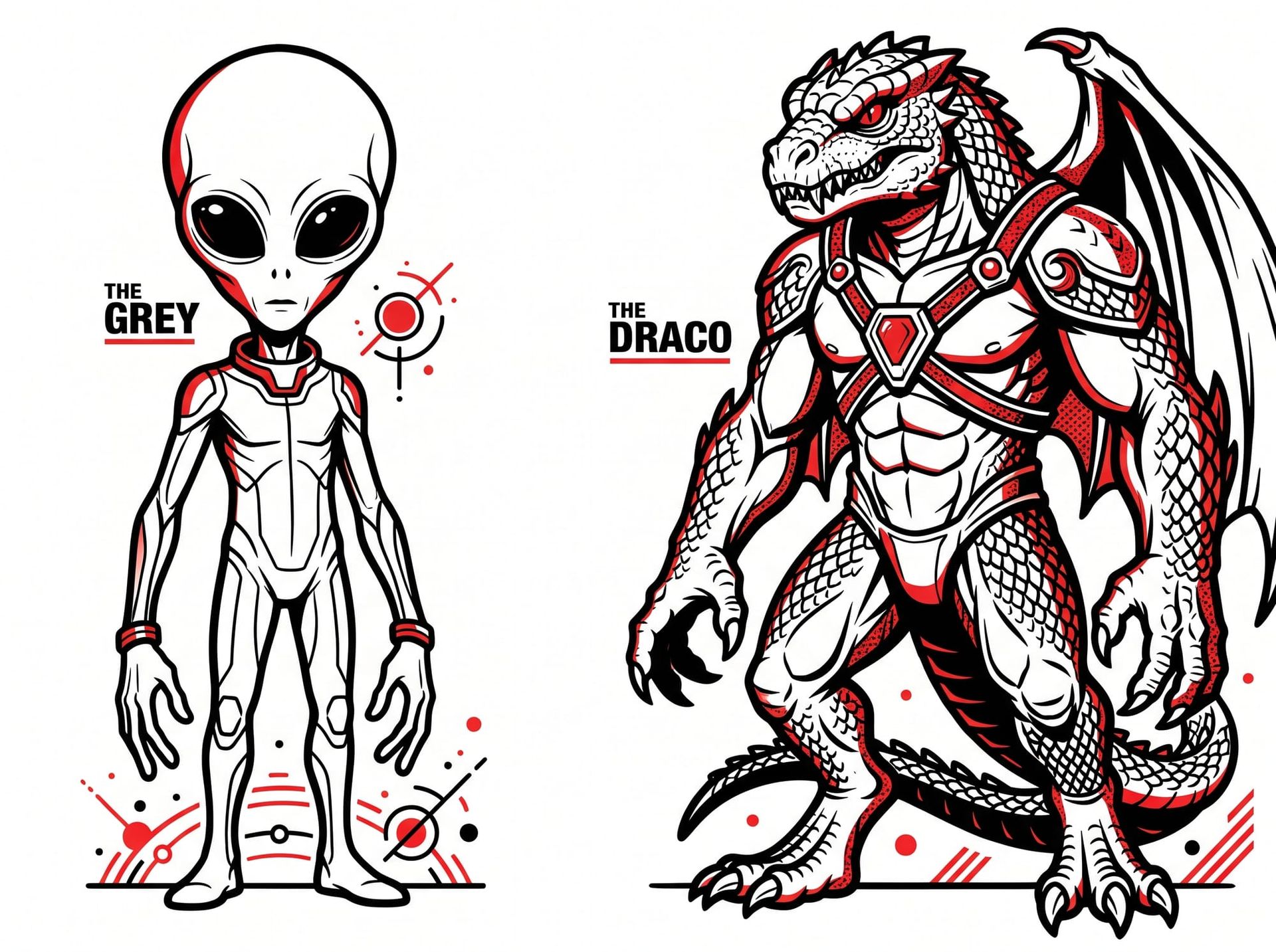
No one has ever produced a Grey, yet the whole world draws the same face. Verso traces how a 1964 TV episode, a Spielberg film and a 1987 book cover built the Grey, and how pulp fiction, hypnosis and a 1903 forgery produced its reptilian rival, the Draco.
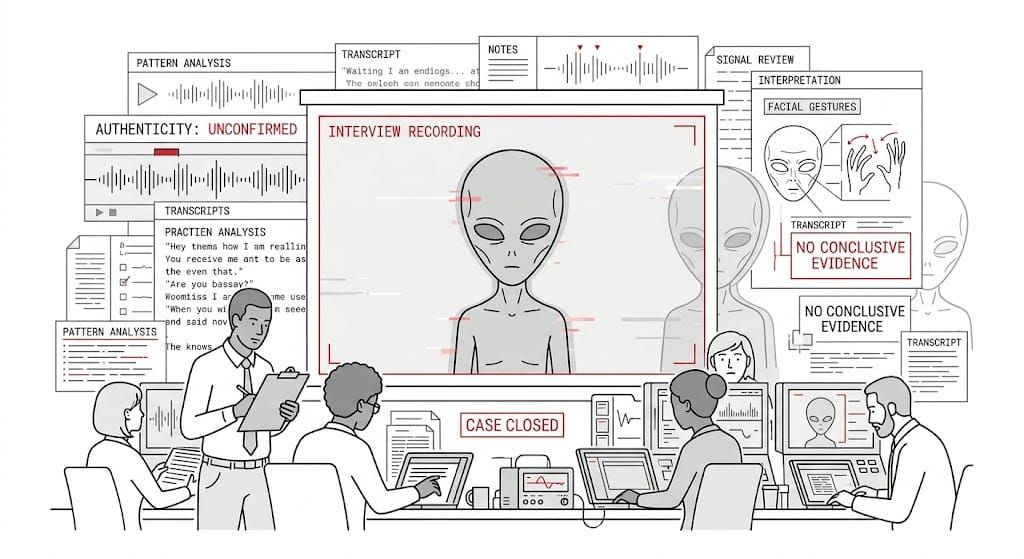
Ask anyone on earth to draw an alien, and the result will be nearly identical. A pale, hairless head too large for its body. A small chin. No real nose, a slit for a mouth, and two enormous black eyes that curve around the sides of the skull like the visor of a motorcycle helmet. The Grey is the most recognizable nonhuman face ever imagined, and it is worth asking how a creature that no one has ever produced, photographed under controlled conditions, or left behind in a morgue drawer became so stable that children in Lyon and Lawton sketch it the same way. The short answer is that the Grey was assembled, piece by piece, over roughly twenty-five years by a handful of witnesses, a television writer, a film studio, and a painter working in a small apartment on East 83rd Street. The longer answer says something about how belief is manufactured, and it eventually leads to the Grey's darker cousin: the reptilian Draco.
The ancestral record is less uniform than the modern image suggests. In the 1950s the dominant visitors were the tall, benevolent "space brothers" of the contactee movement, and the creature reports of that decade ranged from hairy dwarfs to glowing-eyed giants. When Verso surveyed the FBI's 1947 and 1949 files in When the FBI Investigated Flying Saucers and J. Edgar Hoover's Flying Saucer Problem, what the Bureau was chasing were discs, lights, and debris, not occupants. The occupant, and especially the grey occupant, arrived later, and it arrived through one marriage.
In September 1961, Betty and Barney Hill reported losing time on a dark road through New Hampshire's White Mountains. Their story stayed largely private until newspapers broke it in 1965, and historians of the subject generally credit that coverage with making the grey-skinned humanoid famous. What tends to get lost is how much the beings changed between the event and the telling. Betty's own early written accounts described short, black-haired men with large noses she compared to Jimmy Durante. The bald head, the grey skin, and above all the wraparound eyes first appeared in Barney's hypnosis sessions with the Boston psychiatrist Benjamin Simon, and Barney's drawing of those eyes is dated February 22, 1964.
Twelve days earlier, on February 10, 1964, ABC had aired an episode of The Outer Limits called "The Bellero Shield." Its alien, played by John Hoyt, has a bald head, pale skin, and eyes that wrap around the face. In a 1990 essay titled "Entirely Unpredisposed," the researcher Martin Kottmeyer pointed out the timing and argued that wraparound eyes were so rare in screen science fiction that the overlap was hard to dismiss. The writer Jason Colavito later reviewed every Outer Limits episode from that winter and concluded that two others, "The Invisibles" and "The Children of Spider County," accounted for further details in Barney's hypnotic account. Kottmeyer disputed that extension, and Betty Hill told a researcher she had never heard of the show. No document proves Barney watched the episode. What the record does establish is sequence: the face did not exist in the Hills' testimony until after it had existed on national television.
That is not the same as proving the Hills invented anything. Barney Hill was a Black postal worker married to a white social worker in early-1960s New England, under real strain, and hypnotic regression is now understood to be a poor instrument for retrieving memory and an excellent one for blending memory with suggestion. Colavito has argued that the racial anxieties in Barney's sessions echo the plot of "The Bellero Shield" as well as its creature. The more defensible conclusion is that something frightened two people on that road, and that the shape they eventually gave it was borrowed from the culture around them. The case then supplied the second half of the myth. In 1969 an Ohio schoolteacher named Marjorie Fish built a three-dimensional model of the star map Betty said she had been shown and matched it to the Zeta Reticuli system, which is how the Grey acquired a home address.
From there, the image passed from testimony into industry. John G. Fuller's 1966 book The Interrupted Journey and the 1975 television film The UFO Incident carried the Hill beings to a national audience. Then, in November 1977, Steven Spielberg released Close Encounters of the Third Kind. Its little visitors, built by the Italian effects artist Carlo Rambaldi, were mostly played by local schoolgirls from Mobile, Alabama, in grey suits and masks, backlit so that only a slender, large-headed silhouette read on screen. The film borrowed its title from the astronomer J. Allen Hynek's classification system and its creatures from the abduction literature, then returned those creatures to the culture at a scale no witness could match. Readers of L'Orbe et l'Écran will recognize the loop: Spielberg did not simply depict the phenomenon, he became one of its main suppliers of images, and his Disclosure Day this past June is the latest turn of that wheel.
The final piece was a single painting. On the night after Christmas 1985, the horror novelist Whitley Strieber reported an encounter at his cabin in upstate New York. His account, Communion, appeared in February 1987 and spent about six months on the nonfiction bestseller lists. The cover was painted by the realist artist Ted Seth Jacobs, who later explained that Strieber sat beside him and corrected the drawing until he judged it accurate, pushing the face toward something fragile and vulnerable. The result, a light-bulb skull with vast, inky, almond eyes, staring directly out of the jacket, became for many people the first fully rendered alien face they had ever seen. Abduction researchers and psychiatrists of the period recorded patients who said the cover triggered fragmentary memories of their own. Skeptics have offered competing readings of that effect, including the suggestion, circulating among online researchers and not established by any documentation, that the portrait's proportions echo the big-eyed waifs of the painter Margaret Keane, whose mass-produced prints were everywhere in mid-century homes. Even the abduction movement was divided on the image: Budd Hopkins, by several accounts, disliked its proportions.
Why did this face win? Part of the answer is simple repetition. The Hill case, Close Encounters, Communion, and later The X-Files reinforced one another for three decades, and each new witness had more opportunity to have seen the face before reporting it. Part of it is design. The Grey is neotenous, carrying the oversized cranium and eyes of an infant on the body of an adult, and human beings are wired to fix on exactly those features. When Rambaldi later designed E.T., Spielberg reportedly told him the creature had to be innocent, a blend of an old man and a child. The Grey sits on the cold side of that same formula: childlike enough to hold the gaze, blank enough to frighten. The eyes, without whites or irises, give away nothing, which allows each viewer to project whatever the encounter is supposed to mean. A Grey can be a clinical surgeon in Hopkins's case files, a philosophical trickster in Strieber's books, or, as Verso showed in The Grey Who Said He Was From Earth, a CGI figure in Spiro Tsirbas's 2016 video, convincing enough to fool millions precisely because it matched the template they already carried.
There is a harder possibility that a fair account has to keep open. Jacques Vallee has argued for decades that the phenomenon, whatever it is, adapts its presentation to the observer's culture, so that fairies, airships, and Greys may be successive costumes of something that does not have a fixed shape. That theory cannot be tested with the records currently available. Nothing in the rolling PURSUE releases at war.gov/ufo, including October's seventh tranche, or in AARO's published case resolutions, contains a verified physical description of an occupant. The documented history of the Grey is a history of images. Whether there is anything behind the images is a separate question, and it is one the government's own files have not yet answered.
If the Grey is the alien as clinician, the Draco is the alien as conspirator. In the modern lore, which Verso catalogued in A Field Guide to the Visitors, the Draco or Draconians are tall, scaled reptilian humanoids said to originate in the constellation Draco, sometimes specifically from its star Alpha Draconis, also called Thuban. They are cast as an ancient, militaristic empire, often at war with benevolent human-looking races from Lyra or the Pleiades, and frequently said to have arrived on Earth before humanity, to hide underground, and to rule covertly. None of that comes from a government document. It comes from a genealogy of fiction, testimony, and conspiracy literature that can be traced with some precision.
The literary root is pulp fiction. Robert E. Howard's 1929 story "The Shadow Kingdom" introduced serpent men who used sorcery to wear human faces and infiltrate a royal court, and the image passed through Clark Ashton Smith and the H. P. Lovecraft circle into occult writing. In the mid-twentieth century, the American occultist Maurice Doreal folded serpent people into his "Emerald Tablets" mythology, which later fed directly into the conspiracy canon. The first widely cited abduction account involving reptilian beings came in 1967, when Herbert Schirmer, a police officer in Ashland, Nebraska, recalled under hypnosis being taken aboard a craft by humanoids with a faintly reptilian look who wore a winged-serpent emblem on their chests. Schirmer's account, like Barney Hill's, emerged through regression, and skeptics have long treated it as a hoax. It remains a single-witness claim.
The Draco as a political idea belongs to one man more than any other. In his 1999 book The Biggest Secret, the former footballer and broadcaster David Icke argued that tall, blood-drinking, shape-shifting reptilians from the Alpha Draconis system, now hiding beneath the earth, control humanity through human-looking hybrid bloodlines placed in royal families, banks, and governments. Icke drew on the Zulu healer Credo Mutwa's folklore and on earlier pseudohistory; the historian Edward Guimont has traced parts of the theory to colonial-era legends invented around Great Zimbabwe to deny African authorship of its ruins. The most serious problem, though, is documented in Icke's own citations. He has endorsed The Protocols of the Elders of Zion, the 1903 forgery that fabricated a Jewish plan for world domination, and has named the Rothschild family among the reptilian lines. Icke denies that "reptilian" is a code word, but critics across the political spectrum have noted that the structure of the theory, a secret bloodline controlling money and power and harming children, maps almost exactly onto the oldest antisemitic libels. The Draco, in other words, was not only imagined; it was imagined on top of a template with a body count.
The lore kept growing after Icke. Around 1999 and 2000, a Swedish writer using the pseudonym Ole K circulated the "Lacerta Files," supposed interviews with a female reptilian who described an underground species predating humanity and able to pass as human through mind control. Its original translator, Pfeiler, told his webzine readers in 2000 that it was a simple hoax, and it has thrived online regardless, much like the Victor tape and the Anunnaki hybrid video examined in The Others Who Spoke. Later books, including Len Kasten's Alien World Order, wove the Draco into a complete galactic history with invaded star systems and destroyed planets, presented as recovered fact and resting on channeling, contactee testimony, and the Lacerta material itself.
How many people actually believe it? In 2013, Public Policy Polling asked American voters whether shape-shifting reptilian people control the world by taking human form, and 4 percent said yes while another 7 percent were unsure. Headlines converted that into twelve million believers. The psychiatrist and blogger Scott Alexander countered that roughly that share of any survey sample gives absurd answers out of mischief, confusion, or hostility toward pollsters, a margin he named "Lizardman's Constant." Both readings are probably partly true, and the sincere fraction has not been harmless. The man who bombed downtown Nashville on Christmas morning 2020 had absorbed reptilian conspiracy material, and researchers have documented its migration into QAnon.
Set side by side, the two archetypes reveal what each era feared. The Grey crystallized in the 1960s through the 1980s, a period anxious about medicine, surveillance, and the body: it probes, samples, and erases memory, a nightmare of clinical procedure performed by a faceless institution. The Draco rose in the 1990s, when the Cold War enemy had vanished and suspicion turned inward toward banks, monarchs, and globalized power: it does not abduct people, it governs them. One is a story about what is done to the self, the other about who secretly owns the world. Both were shaped by hypnosis sessions, pulp fiction, television, and charismatic authors, and both are documented far better as cultural artifacts than as biological species.
That does not close the question entirely. The 1960 Brookings Report warned NASA that evidence of extraterrestrial life could unsettle societies in ways no one could predict, and the archetypes are, in part, the forms that unsettlement has already taken. If a genuine nonhuman presence were ever confirmed, the public would meet it carrying a face from a 1964 television episode and a fear from a 1903 forgery. Whatever the Department of War eventually releases, the more revealing archive may be the one we built ourselves, frame by frame and page by page, long before anyone asked us to look.
Works Cited
- Colavito, Jason. "The Outer Limits and the Barney Hill Hypnosis Session: Strange Parallels." jasoncolavito.com
- Colavito, Jason. "New Documents Offer Insight into Barney Hill's Racial Paranoia and His Alleged Alien Abduction." jasoncolavito.com
- Colavito, Jason. "On the Reptilians and the Persistence of Myth." jasoncolavito.com
- Dunning, Brian. "Betty and Barney Hill: The Original UFO Abduction." Skeptoid, episode 124, October 21, 2008. skeptoid.com
- Lippard, Jim. Letter on the Hill abduction and The Outer Limits. Fortean Times 302, July 2013. discord.org
- "Grey alien." Wikipedia. en.wikipedia.org
- "The Bellero Shield." Wikipedia. en.wikipedia.org
- "Communion (book)." Wikipedia. en.wikipedia.org
- "Communion: A True Story" (Ted Seth Jacobs on painting the cover). Anomaly Archives. anomalyarchives.org
- "Communion Book Cover" discussion thread (reader recollections; Keane comparison is forum speculation). Metabunk. metabunk.org
- "15 Things You May Not Know About Close Encounters of the Third Kind." Mental Floss. mentalfloss.com
- Titze, Anne-Katrin. "A Grand Legacy: Vittorio Rambaldi on the Legendary Carlo Rambaldi." Eye for Film, December 19, 2025. eyeforfilm.co.uk
- "Reptilian conspiracy theory." Wikipedia. en.wikipedia.org
- "David Icke." Wikipedia. en.wikipedia.org
- "QAnon's Capitol Rioters, Nashville Bomber's Lizard People Theory." NBC News Think. nbcnews.com
- "The Lacerta Files" (on the hoax and its persistence). The Skeptic (UK). skeptic.org.uk
- Kasten, Len. Alien World Order. Bear & Company. simonandschuster.co.uk
- "Americans Believe a Lot of Conspiracy Theories" (Public Policy Polling, April 2013). Salon. salon.com
- Alexander, Scott. "Noisy Poll Results and Reptilian Muslim Climatologists from Mars" (Lizardman's Constant). Slate Star Codex, April 12, 2013. slatestarcodex.com
- PURSUE UAP records. U.S. Department of War. war.gov/ufo
Subscribe to our newsletter
Subscribe to our newsletter to get the latest updates and news








Member discussion