
The FBI's Secret UFO Files: What Declassified Documents Reveal About the 1947 Flying Disc Investigations

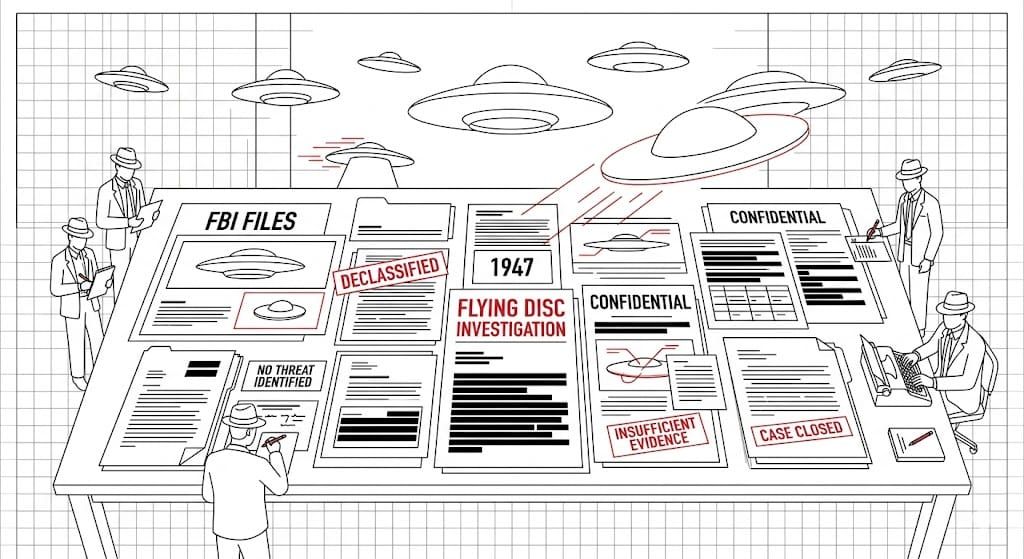
In the summer of 1947, the United States government was quietly building a paper trail of one of the most compelling and bizarre episodes in American history. Declassified FBI files reveal a sprawling, often chaotic investigation into reported sightings of "flying discs" across the Pacific Northwest and beyond, drawing in military intelligence officers, civilian witnesses, tabloid opportunists, and even MIT scientists. Here is what those documents actually say.
The Muroc Airfield Affidavits: Credible Military Witnesses
Some of the most striking testimony in this file comes from sworn affidavits taken at Muroc Army Airfield (now Edwards Air Force Base) in California. These are not the accounts of fringe civilians. They are signed statements from military personnel who witnessed unexplained aerial phenomena on July 8, 1947.
One witness stated that at approximately noon on July 8, while at Muroc, he observed, approximately 5 to 8 miles to the north, what appeared to be a thin metallic object. The object appeared metallic because the method in which it was flying caused the sun to reflect off what looked like an aluminum colored surface. It moved from an intermediate altitude in an oscillating fashion, nearly reaching ground level, then climbed again to a fairly high altitude before drifting slowly into the distance. The witness estimated the object to be the size of a pursuit airplane, but it had no shape resembling any conventional aircraft. His wife observed the same object simultaneously, and the sighting lasted approximately eight minutes.
A second affidavit, signed by a non-commissioned officer at the 4144th Army Air Force Base Unit, describes observing two flying, disc or saucer shaped silver colored objects flying in a northwestern direction at an estimated speed of 350 to 400 miles per hour at an altitude of approximately 7,500 feet. The witness was emphatic: he could not hear a motor roar like any of their planes, it could not have been a balloon, and he was of good health and sound mind, making clear this was no hallucination.
A third and particularly detailed affidavit describes an observer sitting in an observation truck located in Area 3 at Rogers Dry Lake who, while watching P-92s and an A-26 aircraft flying at 20,000 feet, observed a rounded object, white aluminum in color, descend at three times the rate observed for a parachute that was ejected thirty minutes later. The object had a distinct ovular outline with two projections on the upper surface which might have been thick fins or nobs, and these crossed each other at intervals, suggesting either rotation or oscillation of a slow type. No smoke, flames, propeller arcs, engine noise, or other classifiable means of propulsion were noted. The observer believed, from the outline and functional appearance, that it was a man-made object.
A fourth witness described observing two silver objects of either a spherical or disc-like shape moving at approximately 300 miles per hour at about 8,000 feet, heading toward Mojave, California. He brought three other personnel outside to observe and all confirmed seeing the objects. A few minutes later, a third disc appeared, flying in tight circles at the same altitude, and this object's maneuver convinced the witness it could not be any type of aircraft he knew of, any type of bird, or a weather balloon.
The Fourth Air Force headquarters formally recorded these incidents but concluded that no further investigation would be conducted, a decision that would become a recurring theme.
The Maury Island Affair: Where the Story Gets Dark
Among the most complex cases in this file is the so-called Maury Island incident near Tacoma, Washington, which spiraled from a UFO sighting report into a story involving crashed aircraft, dead Army intelligence officers, anonymous phone calls, and what investigators would ultimately conclude was an elaborate hoax.
The story began when a man reported that while patrolling in his boat near Maury Island, Washington, around June 23 or 24, 1947, he witnessed five or six flying discs, one of which appeared to be in trouble. Another disc came over and appeared to make contact with the troubled object. After approximately two minutes of contact, the object in distress threw debris from one of its portholes. This debris landed on the boat, broke the wheelhouse, damaged the spotlight and klaxon, killed the witness's dog, and reportedly struck his son. The witness described the discs as circular, approximately 100 feet in diameter with a 25 foot opening in the center through which the sky was visible. Portholes were described as visible on the inside of the ring. Their speed was negligible as they appeared to hover.
A publisher from the Venture Press in Evanston, Illinois, contacted the witness after flying disc stories began circulating, offering to pay expenses plus a nice amount to make it worth his while if the witness would travel to Tacoma to let Kenneth Arnold, the businessman from Boise, Idaho who had first publicly reported flying disc sightings, check the story. Army intelligence officers Captain William Davidson and Lieutenant Frank Brown from Hamilton Field were subsequently invited to a meeting at room 502 of the Winthrop Hotel in Tacoma on the night of July 31, 1947.
What happened next was tragic and strange. Davidson and Brown departed the hotel around midnight in a B-25 bound for Hamilton Field, reportedly carrying a box of the alleged disc fragments. The left engine burned out an exhaust stack, caught the left wing afire, and the wing broke off, tearing off the tail. The B-25 crashed near Kelso, Washington at approximately 2:50 AM on August 1, 1947, killing both officers. A crew chief and a hitchhiker parachuted to safety.
Before the Army had even officially released the names of the dead officers, five anonymous phone calls had been placed to reporters at the Tacoma Times and a United Press correspondent, providing accurate details about the crash, the officers' identities, and claiming the plane had been shot down or sabotaged because it was carrying flying disc fragments. When the Army subsequently confirmed the officers' names, the callers' prior knowledge became a sensation.
FBI investigation ultimately concluded the B-25 crash reflected a burned exhaust stack catching the left wing afire, with no indication of any sabotage whatsoever. The "disc fragments" were determined by those who had closely examined them to strongly resemble slag from a nearby smelter. The two men who originally claimed to have found the fragments admitted to a signed statement that the rock formations they had found on Maury Island and sent to the Venture Press publisher had no connection with any flying disc. One of them admitted that a remark he made to the publisher, that the material could have been portions of a flying disc, was entirely false.
As for the anonymous calls, the FBI found them most likely to have been made by one of the original witnesses in order to build up the flying disc story to the point where they could make a profitable sale of the story to a Chicago publication. The original account of discs over Maury Island, so compelling in its detail, was characterized by the Seattle Post Intelligencer's own representative as a plain fantasy that had been dreamed up, a conclusion he said was delivered to him by the witness's own wife.
The Tacoma Investigation: Surveillance, Journalism, and Paranoia
What makes the FBI file on the Maury Island case so extraordinary is not just the hoax itself, but the atmosphere surrounding it. Room 502 of the Winthrop Hotel became the center of an intelligence operation that felt more like a Cold War thriller than a government fact-finding mission.
A United Airlines pilot who attended the meeting reported that the room appeared to be either under surveillance or wiretapped. An anonymous caller told him someone had been providing the Tacoma Times with a blow-by-blow description of all that has taken place in your room since you arrived. When pressed on why he was providing information about the investigation, the anonymous caller stated he was not doing it for the newspapers, but that he was interested in seeing that the information got back to New Jersey, a phrase that appears in multiple accounts of the calls and which was never explained.
The same anonymous caller claimed the B-25 had been shot down with a 20 millimeter cannon and that a Marine plane found wrecked on Mt. Rainier had also been shot down. He claimed one of the parties involved would be flown to Alaska, that another would be called back to Wright Field on Tuesday, and that a United Airlines pilot named in the calls had been shot at over Montana. All of these claims were checked and found to be false.
Army Air Force intelligence concluded in its summary report that the anonymous mystery caller in Tacoma was most probably the same individual who had initiated the original Maury Island story, though no definitive identification was ever made.
The Guam Report and Other Military Sightings
The Maury Island case dominates the file, but it is not the only military intelligence reporting captured here. A Weekly Intelligence Summary from Air Transport Command dated August 20, 1947 reports that three American enlisted men of the 147th Airways and Air Communications Service Squadron at Harmon Field, Guam observed two small, crescent shaped objects at approximately 1040 hours on August 14, 1947, traveling at twice the speed of a fighter plane in a westerly direction at an approximate altitude of 1,200 feet. The objects disappeared into clouds, and a few seconds later a similar object, possibly one of those previously observed, emerged from the clouds and proceeded west. The report offered no further details.
A teletype from the FBI's Butte, Montana field office reported that a man and his two sons, ages ten and eight, observed an object nine miles northwest of Twin Falls, Idaho on August 13, 1947, proceeding down the Salmon River at an estimated speed of 1,000 miles per hour. The object was described as twenty feet long, ten feet wide, ten feet thick, light sky blue in color, with flames emanating from its sides. All three heard a loud swish when the object disappeared.
The Metal Fragments at West Rindge, New Hampshire
A separate and intriguing thread in the file concerns metal particles observed at West Rindge, New Hampshire on July 7, 1947. A spectographic examination conducted at MIT determined the fragments to be ordinary cast iron which had been subjected to a very high degree of heat, the heat having caused scales to form on the cast iron which were originally thought to be of some metallic alloy.
The examining scientist concluded that if the fragments had come through the air from any great altitude in as small pieces as they were found, most of the heat would have been taken from them before reaching the ground, and fires would not have resulted. Measurements of four pieces examined revealed they had most likely been originally all part of one hollow cylinder, eight inches in diameter and three sixteenths of an inch in thickness.
In one of the more startling details in the entire file, an unidentified scientist recalled that cast iron cylinders of similar measurements had been used in New Mexico on research work on a guided missile project. The report immediately followed this with the qualifier that this scientist did not so conclude to the exclusion of all other possibilities. The case was closed by the Boston field office.
The Flying Saucer Convention of Alexandria, Louisiana
Not everything in this file involves crashed aircraft and shadow callers. A July 1949 memo from the New Orleans field office reported that citizens in Alexandria, Louisiana had recently seen flying discs, which were being covered extensively in local newspapers. A member of the Young Mens Business Club had suggested promoting a convention of flying saucer seers to capitalize on Alexandria's reputation as a convention city. After an Associated Press release on the proposal, the organizers reported they had received requests from many parts of the United States from people claiming to be flying saucer seers who wanted to attend.
The FBI's commentary on this was characteristically pragmatic: such an enterprise might cause people to falsify that they have seen flying discs or flying saucers in order to attend or become official delegates.
A representative of the Air Force from Barksdale Field, Louisiana had also inquired about the convention plans, stating they were interested in furnishing an observer if such a convention were held.
The Broader Picture: What the Government Actually Knew
The Fourth Air Force's intelligence apparatus was clearly taking these reports seriously enough to investigate, interview, and document, while simultaneously being quick to officially close cases and discourage further inquiry. A memo from Major General Twining at Wright Field, obtained through an Oregonian reporter who had interviewed pilots and Army intelligence officers, conveyed the impression that the AAF instituted its disc investigation to wash out the disc reports since they are definitely not of AAF origin.
The Army intelligence report on the Muroc and Tacoma investigations, signed by Lt. Colonel Donald Springer of the Fourth Air Force, recommended that no further investigation be undertaken on specific incidents by Army Air Force personnel. In the Tacoma case specifically, it was recommended that consideration be given to revoking the Air Reserve commission and flying status of one individual connected to the Maury Island affair as an undesirable and unreliable officer.
The FBI maintained its own parallel interest through the coordination agreement with Army Air Force intelligence, though internal memos suggest the Bureau grew increasingly skeptical of the disc reports and increasingly reluctant to devote investigative resources to them. A 1949 memo regarding a sighting in Canada noted that full information had been furnished to Air Force Intelligence at Fort Crook, Nebraska and that the Bureau would not be separately notified unless advised to the contrary, a line suggesting that the informal intelligence sharing arrangement was being quietly wound down.
What Remains Unexplained
After reading all 74 pages of this file, what is striking is not the evidence of a government cover-up but rather the evidence of genuine confusion. Multiple credible military witnesses, including officers with combat flying experience, observed objects they could not identify and could not explain away as aircraft, birds, or balloons. The Air Force investigated and then effectively closed its eyes. The Maury Island case, whatever its hoax elements, was surrounded by genuinely strange circumstances, including the death of two intelligence officers, anonymous calls with information that could not have been publicly known, and a surveillance situation at the Winthrop Hotel that multiple witnesses reported independently.
The fragments turned out to be slag. The disc stories turned out to be exaggerated or fabricated. The B-25 crash turned out to be a mechanical failure. But the affidavits from Muroc Airfield sit in this file unresolved and unexplained, signed by people who had no apparent motive to lie and every professional reason to be careful about what they put their names to.
The summer of 1947 was the beginning of something. These documents capture the government at the moment it first had to decide what to do about it, and the answer, ultimately, was to look away.
Subscribe to our newsletter
Subscribe to our newsletter to get the latest updates and news












Member discussion