
The NSA Reviewed Warren Commission Evidence for Secret Codes. It Found Nothing. Then It Destroyed Its Copies

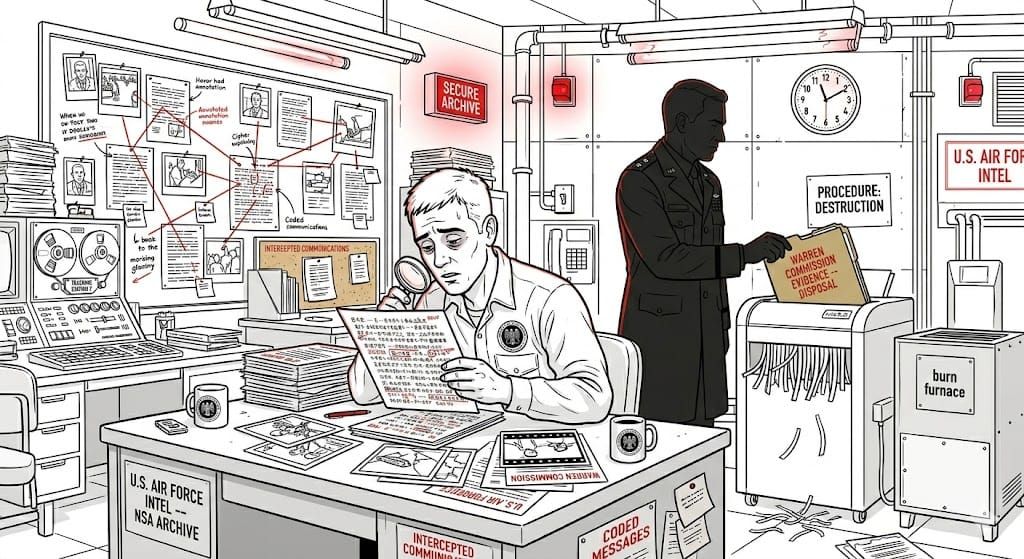
During its investigation of the Kennedy assassination, the Warren Commission quietly handed a set of evidence exhibits to the National Security Agency and asked the NSA's cryptanalysts to examine them for secret writing or coded content. The NSA conducted that review. Its analysts reported to the Commission that they found nothing significant. The photocopies of those exhibits that the NSA retained were subsequently destroyed. No written report was submitted.
More than a decade later, the Senate Select Committee on Intelligence, conducting its own review of the intelligence community's role in the Kennedy assassination investigation, went back to the NSA and asked: what exactly did you do, what did you find, and what happened to the records? This document is the NSA's formal answer to those questions. It is also, read carefully, a document full of qualified language, acknowledged gaps, and a Cuban military alert finding that deserves far more attention than it has received.
What the Document Is
Record 144-10001-10195 is a nine-page packet of three interconnected documents spanning from July 1964 to January 1976. All three were classified at the TOP SECRET level and marked for handling via COMINT channels only, the NSA's most restricted distribution category. The packet was reviewed in November 1997 and withheld. It was released on November 1, 2017 under the JFK Assassination Records Collection Act.
The three documents are: a January 26, 1976 NSA memorandum signed by David D. Lowman, Special Assistant to the Director for Congressional Reviews, addressed to the Principal Deputy Assistant Secretary of Defense for Intelligence; a January 13, 1976 letter from Alton H. Quanbeck of the Senate Select Committee staff addressed to Thomas K. Latimer, Special Assistant to the Secretary of Defense; and a July 10, 1964 letter from J. Lee Rankin, General Counsel to the Warren Commission, addressed to NSA Director Lieutenant General Gordon A. Blake. The packet covers twelve years of institutional history in nine pages.
The 1964 Foundation: What the Warren Commission Asked the NSA to Do
The chronological starting point for this packet is the Rankin letter of July 10, 1964. It is brief and transactional: it authorizes the NSA to retain photographic copies of seven specific items it had used during the Commission's investigation. Those items are Commission Exhibits 31, 15, 104, and 18; the typewritten version of Commission Exhibit 24; and FBI items A-2, A-6, 137, and 152. The letter closes by thanking the NSA for its cooperation. It is a courtesy letter, the kind written at the conclusion of a working relationship, formalizing what the NSA was permitted to keep. But it raises an immediate question the Senate Select Committee would press twelve years later: why did the NSA want to keep those materials, and what had it done with them?
The Commission exhibits the NSA reviewed are not random selections. Commission Exhibit 15 is the backyard photograph of Oswald holding a rifle. Exhibit 31 connects to photography taken in Mexico City during the Commission's investigation of Oswald's presence there. Exhibit 104 relates to a letter Oswald wrote to the Fair Play for Cuba Committee. The typewritten version of Exhibit 24 relates to a note in Oswald's possession. The FBI items involve materials collected from Oswald's possessions and associations. The NSA was examining documents directly connected to Oswald's identity, his communications, and his network of contacts.
The 1976 Senate Questions: What Did You Actually Do?
The January 13, 1976 letter from Alton Quanbeck of the Senate Select Committee staff sets out six specific and pointed questions, underlined in the original document, that Senate investigators wanted answered. The letter was sent to the Department of Defense and copied directly to the NSA's Frank Foster.
Question one asked why the NSA had wanted to keep photocopies of the Warren Commission documents and what use was made of them. Question two referenced a Warren Commission staff internal memorandum reporting that the NSA claimed to have information on names which the CIA did not have, and asked the NSA to identify those names and explain their significance. Question three stated that the CIA had obtained transmissions from the Soviet Embassy in Mexico City for November or December 1963, and asked whether the NSA received those transmissions, analyzed them, and what the results were.
Question four asked for the full extent of NSA files relating to the assassination, requested staff access to those files, and asked for a summary of all information the NSA developed from Cuban or Soviet transmissions relating to the assassination. Question five addressed a specific piece of intelligence the Senate committee said it had received: that after the assassination the Cuban government instructed its embassies and consulates to return all files on Oswald to Cuba, and asked what the NSA knew about whether such instructions were issued. Question six asked whether the materials described in the preceding questions had been provided to the Warren Commission.
Taken together, these six questions constitute one of the most direct documented challenges ever put to the NSA about its role in the Kennedy investigation. The Senate committee was asking whether the NSA had intercepted communications touching on Oswald, on the Soviet Embassy in Mexico City in November and December 1963, and on Cuban government actions regarding Oswald files immediately after the assassination. It was asking whether any of that had been shared with the Warren Commission.
The NSA's Answers, Paragraph by Paragraph
On the Warren Commission document review (question one), the NSA explains it had requested permission to retain photocopies purely as a record of its analytic work, in case questions arose later about manhours expended. The photocopies had no operational use and had been destroyed by January 1976, to the best of the agency's knowledge. The NSA then states its central finding: absolutely no results relevant to the assassination were obtained through NSA's analytic look at the exhibits.
The memo describes what kind of analysis was performed. Allan Dulles, a Warren Commission member and former CIA Director, had asked NSA Director Dr. Louis Tordella, informally, to review the Commission exhibits for secret writing or codes. Tordella had NSA cryptanalysts conduct a careful review. They found nothing. Results were reported verbally to Dulles and other Commission members. No written report was submitted.
Three details here require attention. First, the request from Dulles to Tordella was informal, conducted outside official channels and leaving no contemporaneous paper trail. Second, the results were reported verbally, again creating no written record. Third, the photocopies of the analyzed documents had been destroyed. The entire NSA cryptological review of Warren Commission evidence was conducted informally, reported orally, and left behind no surviving documentation.
On question two, regarding names the NSA had that the CIA did not, the NSA states it is uncertain what the Commission staff memorandum was referring to. It offers two possibilities: its biographic files on foreign personalities of intelligence significance, or the broader phenomenon of foreign names appearing in intercepted communications traffic that would not otherwise be available to the intelligence community. The NSA does not identify any specific names and does not confirm it provided any name-based intelligence to the Commission.
On question three, the Soviet Embassy Mexico City transmissions, the NSA's response is the most evasive in the document. It states that it may well be that the CIA obtained such transmissions and passed them to NSA for analysis, but no one currently working in that analytic area recalls such a request. Dr. Tordella could not shed light on the subject. No files or records from that time frame have been located that would substantiate such a claim. The only recovered file is one compiled from open sources listing major dates in the last months of Oswald's life, apparently built to be compared against NSA SIGINT product in hopes of finding matches. That file contains no hits. The analysts who performed this effort have since retired.
The qualifications layered through this paragraph are notable. The NSA does not say it never received Soviet Embassy transmissions from Mexico City. It says it may well have received them, but no one remembers, Tordella could not clarify, and no records have been found. The only surviving trace of any analytical effort is an open-source chronology that yielded nothing, built by analysts who have since retired and cannot be questioned.
On question four, the full extent of NSA involvement, the memo delivers the agency's most definitive statement: the informal request from Dulles asking Tordella to review Commission exhibits is the known total extent of NSA's role in assisting in the investigation. There is no information now identifiable that was developed from Cuban or Soviet transmissions relating to the assassination.
The Cuban Military Alert: The Most Important Finding in the Document
Paragraph five of the Lowman memo is the most operationally significant section of the NSA's response, and almost certainly the most underreported finding in this packet. The NSA states it has no information on the question of whether Cuba issued instructions to its embassies to return Oswald files. But it then discloses what a manual file search, prompted by the January 20 interview with Tordella, actually recovered.
Three SIGINT product reports, attached as Inclosures 2, 3, and 4 and numbered 2/O/R66-63, 2/O/R196-63, and 2/O/R58-63, show that Cuban military forces did go on alert immediately after the assassination. The NSA then draws an explicit conclusion: there is no SIGINT evidence that the Cuban forces were alerted prior to the assassination, thereby suggesting that they had prior knowledge of the event.
This is a precisely worded and consequential finding. The NSA is not saying Cuba was uninvolved. It is saying that its signals intelligence record shows Cuban military forces responding to news of the assassination after it occurred, not positioning themselves before it happened. The absence of a pre-assassination military alert in the SIGINT record is material evidence bearing on the question of Cuban government foreknowledge. Three 1963 NSA product reports support that finding, recovered from the agency's files in 1976, attached to this memo as inclosures. The reports themselves are not part of the released packet visible in this record, but their existence and their summary finding are documented here.
What This Document Reveals About the Warren Commission's NSA Engagement
One of the most important things this packet establishes is that the Warren Commission's engagement with the NSA was conducted in ways that systematically minimized the creation of records. The Dulles-to-Tordella request was informal. The results were reported verbally. The copies were destroyed. The only written trace of the entire engagement is the Rankin authorization letter from July 1964, which says nothing about what the review found.
A Warren Commission staff internal memorandum, referenced in the Senate committee's question two, recorded a belief that the NSA had information on names the CIA did not have. By 1976, the NSA could not confirm, deny, or explain what that intelligence was. Somewhere between 1964 and 1976, whatever name-based intelligence the NSA may have possessed in connection with the assassination became unverifiable. Whether it was never formalized, was destroyed, or was protected under classification authorities that kept it out of the review process is not answered by this document.
How It Fits the Bigger Picture
This document connects directly to the two NSA records examined in the previous entries in this series. In those records, from July and August 1978, the NSA responded to the HSCA's keyword searches and Blakey's queries with negative findings and acknowledged gaps. This document, produced for the Senate Select Committee two years earlier, shows that the pattern of incomplete records and oral-only reporting did not begin with the HSCA inquiry. It began in 1964, with the original Warren Commission engagement.
The Soviet Embassy Mexico City thread is one of the most consequential unresolved questions in the entire assassination record. Oswald visited Mexico City in late September and early October 1963, approximately seven weeks before Dallas, and had contact with both the Soviet and Cuban diplomatic missions there. The CIA was monitoring the Soviet Embassy. Whether the NSA received and analyzed any of those intercepts, and what they showed, has never been definitively established. This document records the NSA saying in 1976 that it cannot confirm or deny having received them, because the people who would know have retired and the records no longer exist.
The Cuban military alert finding, documented through three 1963 SIGINT product reports, is the single most concrete intelligence finding in the entire set of NSA-originated JFK documents examined in this series so far. It is also the finding most directly relevant to the question of Cuban government foreknowledge. The NSA's signals intelligence captured the Cuban military's reaction to the assassination and found it consistent with surprise. That is an investigative conclusion drawn from actual intercept data, produced in 1963 and presented to Senate investigators in 1976.
The Bottom Line
Record 144-10001-10195 spans twelve years of institutional history and covers the full arc of the NSA's engagement with the Kennedy assassination from 1964 through 1976. It documents a Warren Commission that engaged the NSA informally and without creating a written record of findings. It documents an NSA that destroyed its copies, lost track of whether it ever received Soviet Embassy transmissions from Mexico City, and cannot explain what name-based intelligence it may have possessed that the CIA did not. And it surfaces three SIGINT product reports from 1963 showing Cuban military forces going on alert after the assassination, with no detectable pre-assassination alert, the closest thing to a positive intelligence finding on the Cuba-foreknowledge question anywhere in the NSA's JFK-related record.
The Warren Commission's investigation of the Kennedy assassination was shaped not only by what the intelligence agencies found, but by how those agencies chose to conduct their engagement with investigators. This packet is a record of both.
Subscribe to our newsletter
Subscribe to our newsletter to get the latest updates and news






Member discussion