
The NSA Searched for Jack Ruby, Oswald, and a Detroit Dry Cleaner. It Says It Found Nothing

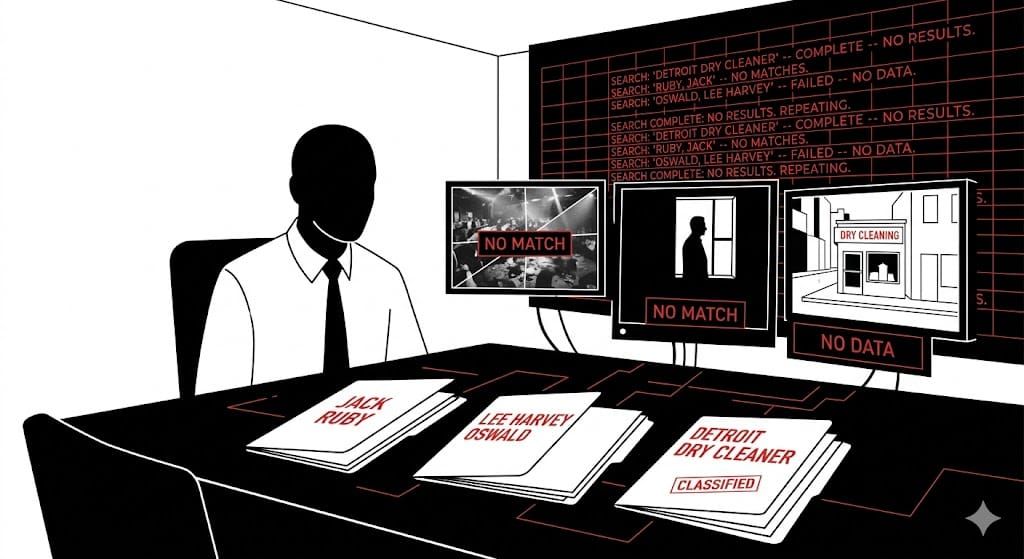
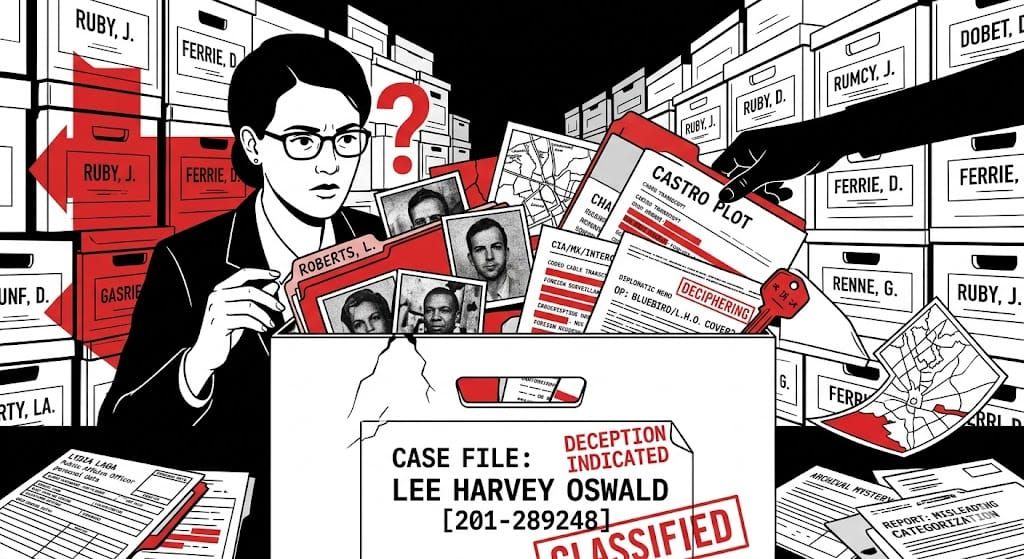
In the summer of 1978, the House Select Committee on Assassinations sent a request to the National Security Agency. The HSCA wanted to know if the NSA had intercepted communications between a Detroit dry cleaning business called Cobo Cleaners and Cuba in March and April of 1962. It also wanted the agency to search its entire signals intelligence repository for any records touching on Jack Ruby, Lee Harvey Oswald, President Kennedy, and several other names and terms.
The NSA's answer, delivered across three SECRET memoranda, was that nothing useful existed. The raw communications data from 1962 had been destroyed per agency regulations. The SIGINT product files from the same period were incomplete, with numerous reports and translations simply not held in the repository. A keyword search of everything that remained turned up no results for any of the names the HSCA was asking about.
That answer is, in its own way, one of the most consequential things in this document. Here is why.
What the Document Is
Record 144-10001-10185 is a five-page packet of three connected SECRET memos, all produced in late July and early August 1978 during the active phase of the HSCA investigation. All three were classified SECRET and marked "Handle Via COMINT Channels Only," the standard handling instruction for signals intelligence material. They were reviewed in July 1997 and held at status X, meaning withheld. They were finally released on November 1, 2017 under the JFK Assassination Records Collection Act.
The cover identification form notes that the document "contains sensitive compartmented information," which in 1978 placed it in one of the most restricted handling categories in the U.S. intelligence community. The fact that this packet required COMINT channel handling means its contents touched on the NSA's signals collection programs, their methods, and potentially the identities of targets or collection sources. Even a memo saying that records do not exist can be sensitive if the absence itself reveals the boundaries of what the NSA was or was not intercepting.
The Three Memos and What Each One Says
- Memo One: G09 to LAO, July 31, 1978
The first memo is signed by E.W. Blake, Chief of G09, and is addressed to the NSA's Legislative Affairs Office. It responds directly to a request from HSCA Chief Counsel G. Robert Blakey for access to all communications between Cobo Cleaners of Detroit, Michigan and Cuba during March and April of 1962. Blake's response establishes three facts in succession. First, in 1962 the NSA's G offices stored records only on page print and microfilm. Second, consistent with agency regulations on records retention, all materials other than finalized product for 1962 had been destroyed. Third, as a direct consequence of that destruction, no raw communications database exists for private communications to or from Cuba for the March and April 1962 period.
The memo then notes that even if any relevant information existed at all, it would exist only as finished NSA product based on those communications, not as the original intercepts. And Blake states that no product files for the relevant period exist within the G Group either. In other words: the agency is telling the HSCA that whatever it might have known about Cobo Cleaners and Cuba in 1962 is gone.
- Memo Two: Legislative Affairs to the NSA Director, August 3, 1978
The second memo, signed by Eugene F. Yeates for the NSA's Legislative Affairs Office and addressed to the Director of NSA, is a brief transmittal note. It informs the Director that an attached memo provides the response to a request from HSCA staffer Judy Miller for NSA to search for records the Committee was interested in. Yeates reports that a thorough search was made with negative results, attaches memos from three internal offices (V, T12, and G), and requests Director approval to forward the response to Miller.
This memo establishes that the search was not a casual inquiry. It went through the Director's office for approval before the response was sent back to the HSCA. The NSA was not simply handing over a file clerk's report. This was an agency-level response that required sign-off from the top.
- Memo Three: T12 to LAO, July 28, 1978
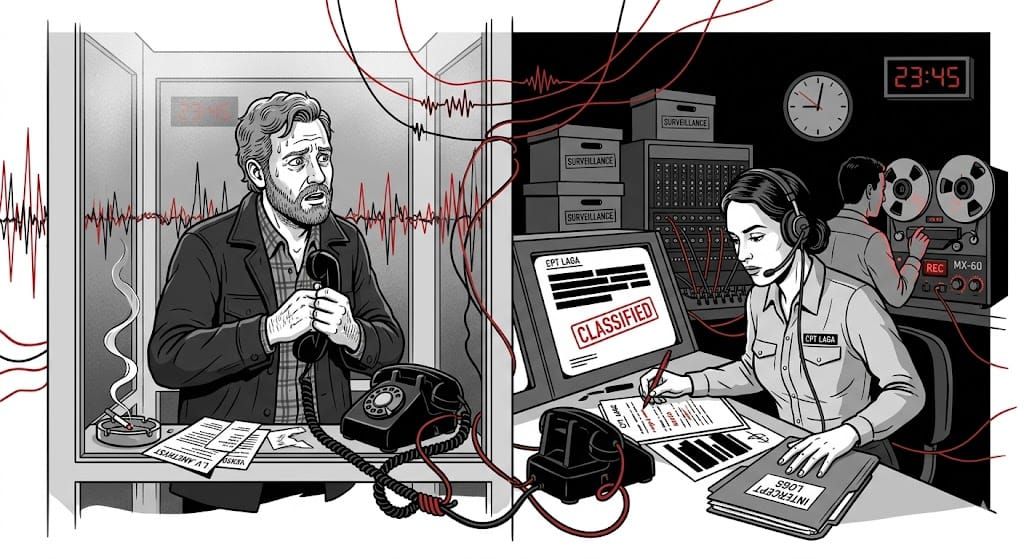
The third memo, from Robert J. Welday, Chief of T12, is the most operationally detailed of the three. It documents the actual SIGINT repository search. T12 searched open series SIGINT product records in the NSA SIGINT Repository, scanning all 1962 NSA-produced SIGINT product in three series designated QOC, QOY, and QOF, limiting to records with a date of information of March or April 1962. Within that filtered set, the search was run against the following keywords: EARL/JACK RUBY, COBO CLEANERS, DETROIT MICHIGAN, PRESIDENT KENNEDY, SERAFIN, VICIENCIA, and OSWALD.
The result was negative. No hits on any keyword. The memo also acknowledges that the search was not exhaustive, because some serial numbers within those series were simply missing from the repository, and the agency could not verify whether product had ever been produced against those missing serials. The search consumed approximately twenty man-hours.
The final page of the packet documents the microfilm copy search conducted by T1244 personnel, listing specific report and translation series numbers across QOC, QOY, and QOF, and identifying by number which reports and translations were not held in the repository. Dozens of individual report numbers across all three series are listed as absent. A cluster of QOC reports numbered 178 through 180 are noted as not readable on film, with a date of issue between August 8 and September 20, 1962, and therefore not recalled for the search. Similarly, QOY translations numbered 500 through 507 are noted as not readable, with an October 1962 date of issue.
Why Cobo Cleaners and Jack Ruby
To understand why the HSCA was asking the NSA about a Detroit dry cleaning business, you need to understand the thread investigators were following.
Jack Ruby, born Jacob Leon Rubenstein in Chicago, shot Lee Harvey Oswald at point-blank range on November 24, 1963, in the basement of the Dallas Police Department, in front of live television cameras. Ruby's shooting of Oswald silenced the only person who could have been tried and cross-examined about Kennedy's death. Ruby himself died of cancer in January 1967 while awaiting retrial, never having provided a credible full account of his motives.
The HSCA investigated Ruby's background extensively and found connections to organized crime figures that the Warren Commission had not fully explored. One line of inquiry concerned Ruby's possible connections to Cuba and to individuals involved in the anti-Castro movement or in organized crime networks that had interests in Cuba before and after the revolution. The Detroit connection matters because Ruby had documented associations with figures in Detroit's organized crime network, and investigators had developed leads suggesting that the Cobo Cleaners business may have had connections to individuals in Ruby's orbit or to financial flows relevant to Cuban exile operations.
March and April 1962 is a specific window: approximately one year after the Bay of Pigs failure in April 1961 and roughly eighteen months before the assassination. It was a period of intense covert activity around Cuba, with the CIA running Operation Mongoose, a broad destabilization campaign against Castro that involved exile networks, organized crime contacts, and communications across the Florida Straits and beyond. If the NSA had intercepted communications between a Detroit business and Cuba during that window, and if those communications touched on any of the names in the HSCA's keyword list, it would have been potentially significant evidence of a network connecting Ruby to Cuban operations.
The names SERAFIN and VICIENCIA in the keyword list are partially redacted in the released document under exemption b(iii), protecting intelligence source and method information. Their inclusion alongside Ruby, Oswald, and President Kennedy tells us the HSCA had developed specific named individuals connected to this line of inquiry whose full identities remain protected even in the 2017 release.
What the Gaps in the Repository Mean
The T12 memo is careful to note that its negative result is not a clean negative. Numerous report and translation numbers across all three SIGINT series are documented as not held in the repository. The agency explicitly states that the existence or nonexistence of product produced against those missing serial numbers cannot be verified. This is a significant qualification.
What it means in plain terms is this: the NSA searched everything it had and found nothing. But it also documented that it did not have everything. Dozens of specific reports and translations from the exact time period the HSCA was interested in were simply absent from the repository. Whether those missing items were never produced, were produced and destroyed under records retention policy, were produced and filed elsewhere, or were produced and removed at some point after filing is not answered by this document.
The G09 memo provides the clearest explanation for the raw data gaps: all non-product materials for 1962 were destroyed per agency regulations. But it does not explain the gaps in the product files themselves, the finished intelligence reports and translations that should have been retained. Those are the items listed as not held in the repository across the final two pages of this packet. The NSA does not explain why finalized intelligence product from 1962 is absent from its own repository. It simply notes the absence and moves on.
The NSA and the HSCA: A Contested Relationship
This document exists within a broader pattern of friction between the HSCA and the intelligence community. The committee's investigators repeatedly encountered situations where the CIA, FBI, and other agencies produced records that were incomplete, where relevant files had been destroyed, and where the agencies' cooperation fell short of what investigators believed was required.
In the NSA's case, the agency's posture throughout the HSCA investigation was one of narrow, technically accurate compliance. The NSA was not in the habit of volunteering information beyond what was specifically requested, and even responses to specific requests were processed through the Director's office, classified at the highest relevant levels, and transmitted through restricted channels. This document is a clear illustration of that posture: the response to Blakey's request is technically complete, carefully qualified, and ultimately conclusory. The records do not exist. The search returned nothing. The inquiry is closed.
What this document cannot tell us is whether the NSA was forthcoming about what it knew from other sources, or what the agency's full picture of Cuban communications activity in 1962 actually contained. The SIGINT collection programs of the early 1960s were extraordinarily broad. The NSA was intercepting communications across the Caribbean basin during the period of Operation Mongoose and the Cuban Missile Crisis. The claim that no relevant product exists in the repository, while simultaneously acknowledging that dozens of reports and translations from that exact period are simply not present, is a response that closes the formal inquiry without resolving the underlying question.
How It Fits the Bigger Picture
Taken together with the other documents in this series, Record 144-10001-10185 occupies a specific and important place in the JFK record. The previous document we examined, the Army intelligence report on Manolo Artime's recruitment activities, showed us a world of active surveillance and contemporaneous reporting on the anti-Castro exile network in November 1963. This NSA document, produced fifteen years later, shows us investigators trying to go back and reconstruct what the signals intelligence apparatus knew about that same world in early 1962.
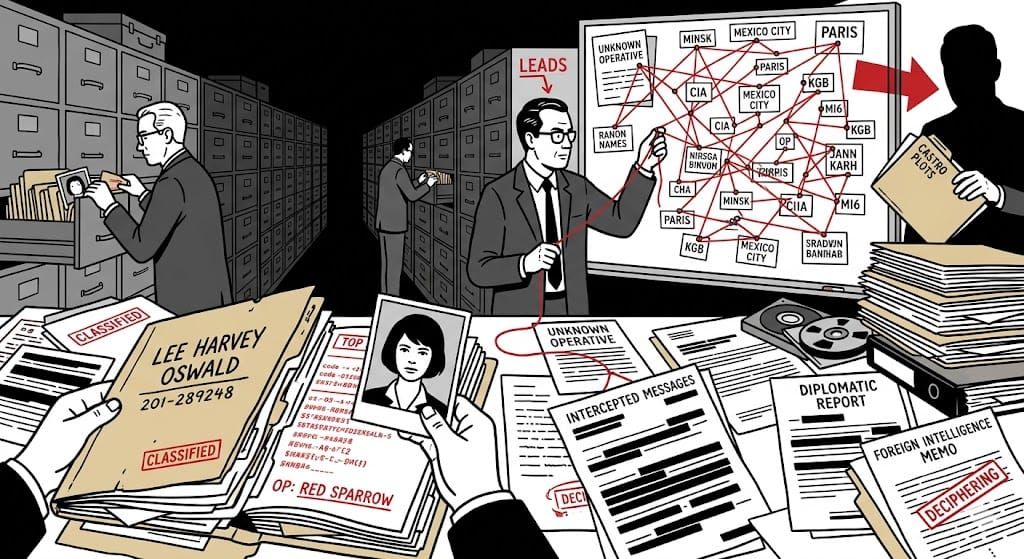
The keyword list is the most revealing single element in this document. The HSCA did not ask the NSA to search for Cobo Cleaners in isolation. It asked for a search that linked a Detroit business to Cuba to Jack Ruby to Lee Harvey Oswald to President Kennedy to at least two partially redacted names. That keyword architecture tells us the committee had built a theory, or at least a hypothesis, connecting those elements. Whatever that hypothesis was, this document records that the NSA's available records could neither confirm nor deny it.
The HSCA's 1979 final report concluded that Ruby's shooting of Oswald was consistent with organized crime involvement and that Ruby had not acted alone in the sense of having been completely isolated from any network or prior arrangement. The committee could not establish definitively what motivated Ruby or who, if anyone, directed him. This document is part of the evidentiary record that shaped that conclusion: a signals intelligence search that returned nothing, against a keyword list that suggests the investigators were looking for something very specific.
The Bottom Line
Record 144-10001-10185 is a document about the absence of evidence. That is not the same thing as evidence of absence. What it establishes, precisely and on the record, is that the NSA was asked to search its SIGINT holdings for communications connecting Jack Ruby, Lee Harvey Oswald, and a Detroit business to Cuba in the spring of 1962. The agency reported that it searched what it had and found nothing. It also documented that significant portions of the relevant records were simply not in the repository.
For readers following this series, the value of this document is in what it shows about how the investigation was conducted: which agencies were asked, what they were asked to look for, how they responded, and what the limits of their records were. The HSCA was working in 1978 with whatever the intelligence community chose to produce. This document is a precise, classified record of one of those exchanges, and its negative findings are as historically significant as any document in this collection that contains actual intelligence content.
The NSA searched for Jack Ruby and Lee Harvey Oswald in its signals intelligence files. It says it found nothing. That is a fact. What lies behind it, in the gaps between the serial numbers that were not held in the repository, remains an open question.
Subscribe to our newsletter
Subscribe to our newsletter to get the latest updates and news






Member discussion