
The Orb and the Screen

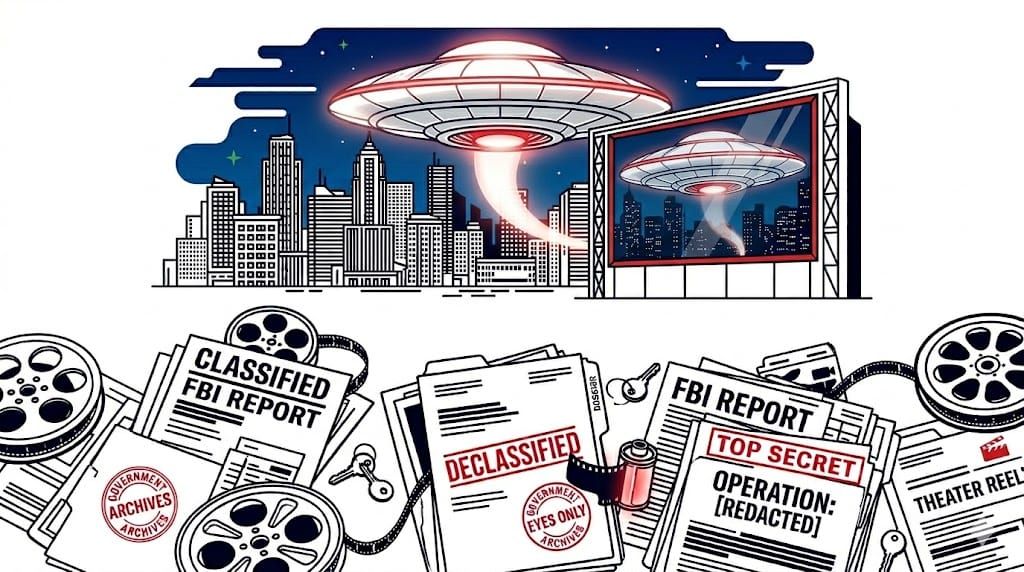
What the declassified files don’t say, is the movie saying it instead?
On June 12, 2026, two things happened on the same day, a few hours apart.
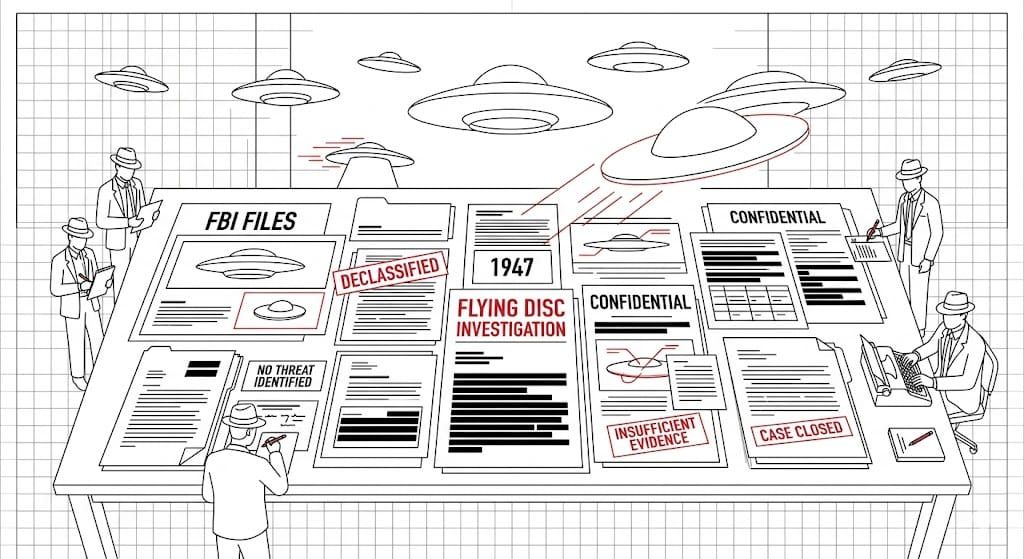
On one side, the Department of War posted the third wave of its PURSUE program (Presidential Unsealing and Reporting System for UAP Encounters) at war.gov/UFO: 72 new items, including the FBI’s first authenticated UFO videos, witness reports filed on FD-302 forms dated this year, an analysis of the Colorado Springs incident, and a 1949 U.S. Army study on flying saucers.
On the other side, Universal Pictures released Disclosure Day, Steven Spielberg’s new film, in theaters. Tagline: “If you found out we weren’t alone, if someone showed you, proved it to you, would that frighten you? This summer, the truth belongs to 7 billion people.”
A calendar coincidence...probably, but one worth pausing on, because it raises the question this piece wants to ask: what if the real disclosure isn’t coming through the archives, but through fiction?
What the files actually show
Let’s start with the real thing, because that’s our job here, and because the real thing, in this case, is disappointing.
Since February 2026, the Trump administration has directed federal agencies to identify and declassify any document related to unidentified anomalous phenomena, the term that has replaced "UFO" in the official vocabulary. Three waves followed: roughly 150 documents on May 8, more than 200 documents and 51 videos on May 22, and 72 additional items on June 12. All of it is hosted on a brand-new government website, accessible without asecurity clearance, billed as the broadest public disclosure on the subject in American history.
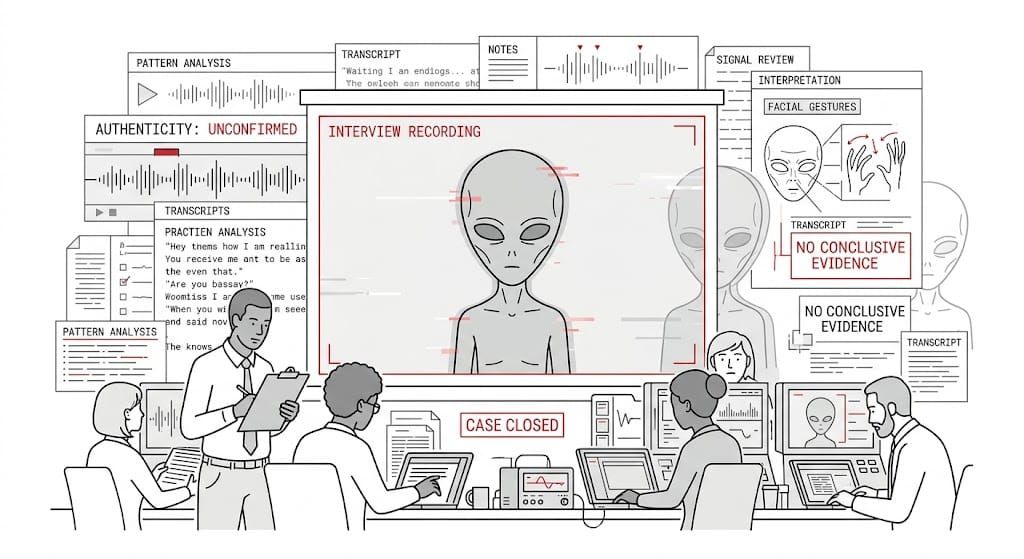
And what’s actually in there? Points of light. Shapes that look like balloons, drones, birds, and sensor glare. A football-shaped object spotted near Japan by Indo-Pacific Command. Three lights above the lunar surface in an enlarged photograph. Witness reports that describe, with unmistakable sincerity, things their authors simply don’t have a name for.
This is exactly the kind of file you’d expect from a system that classifies by reflex, not by necessity. The All-domain Anomaly Resolution Office (AARO), created in 2022, received 757 reports between May 2023 and June 2024. It resolved only 118 of them, mostly attributed to balloons, birds, or drones. The rest remain, by definition, unidentified. Unidentified doesn’t mean alien. It means nobody knows, which is the natural state of most things observed in a sky crowded with millions of flying objects, civilian and military, that no analyst can track and catalog in real time.
Common sense deserves a place here, because it tends to get suspended the moment a file is stamped “SECRET.” If these images really showed an unmistakably non-human craft, intact, photographed under conditions nobody could dispute, the obvious question would be: why was this ever classified in the first place? Classification protects capabilities, sources, collection methods, and occasionally embarrassing incompetence. It does not, generally, protect evidence that doesn’t exist. Eighty years of prolonged silence on this subject looks less like a vault and more like a closet where the government has been stuffing everything it never had time to sort.
It’s worth noting, in passing, that the legal framework behind this disclosure, Record Group 615, created by the 2024 NDAA, was explicitly modeled on the one that governs the release of the JFK assassination files. The same bureaucratic mechanism, the same congressionally forced vocabulary of transparency, the same vertigo in the face of millions of pages where most reveal nothing and a handful, maybe, change everything. Readers who follow our various series will recognize the pattern. It seems like the American state runs on one piece of software for handling its embarrassing secrets: wait, classify, then dump entire boxes of it the day the political pressure becomes impossible to sit on.
So no, the UAP files don’t contain aliens. What they contain is proof, already well established, that the U.S. military sees things in its sky it doesn’t always identify, and that it would rather manage that quietly than admit, in real time, that it doesn’t control everything flying above its bases.
Disclosure Day, or fiction as a back door
Now to the film, and to the theory that actually interests us.
Disclosure Day marks Spielberg’s return to the genre he shaped more than anyone alive: Close Encounters of the Third Kind in 1977, E.T. in 1982, War of the Worlds in 2005. The screenplay is by David Koepp, from a story by Spielberg himself. The cast includes Emily Blunt, Josh O’Connor, Colin Firth, Eve Hewson, and Colman Domingo. Filming took place between February and May 2025 in New York, New Jersey, and Atlanta. The working title during production was The Dish.
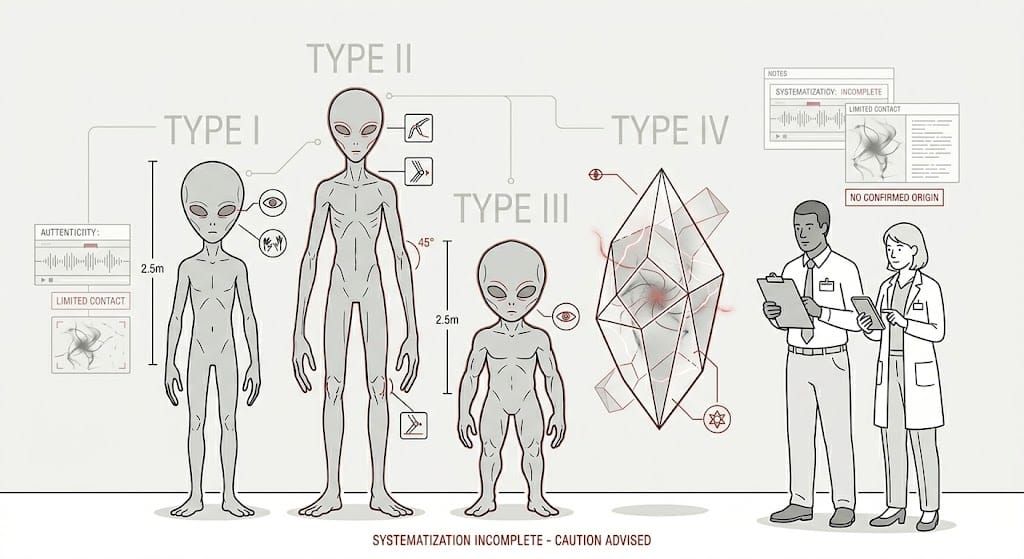
The marketing campaign, carefully metered out over months, fed the public an alien hand here, a human voice dissolving into unsettling clicks there, and a recurring tagline built like a slogan: “This 79 year cover-up has to end.” Seventy-nine years before 2026 lands on 1947. The year of Roswell. The math isn’t subtle, and it doesn’t need to be: it’s marketing, designed to resonate with a collective memory already saturated with UFOs.
Spielberg himself has a personal theory on the subject, laid out in 2023 on Stephen Colbert’s show: UAPs might not come from another galaxy at all, but from our own future, humans traveling back in time to observe us. A comforting idea, almost reassuring, and very much in character for the director of E.T., who has always been more interested in reconciliation than invasion.
This is exactly where the film-as-vehicle theory gets interesting and deserves to be taken seriously without being swallowed whole.
The soft disclosure hypothesis
This instinct isn’t an isolated one. Serious ufology circles (yes, those exist) have talked for years about soft disclosure: the idea that institutions, rather than announcing a destabilizing truth head-on, release it in small doses through channels that let the public absorb it without panicking, while letting the state deny it without technically lying. A documentary here, a calculated leak there, a blockbuster at just the right moment. In this model, fiction isn’t a smokescreen set up against the truth. It’s the decompression chamber that lets the truth in without blowing out the room.
This logic holds up psychologically, even if the term most often reached for to describe it, cognitive dissonance, isn’t quite the right one. In Leon Festinger’s strict original sense, cognitive dissonance describes the discomfort of holding two contradictory beliefs at once, and the way people resolve that discomfort, usually by revising one of the beliefs rather than the facts. What’s actually at work here is closer to what might be called plausible deniability through fictional mediation: showing something while preserving, for the source, the option to say “it was only a movie.” The viewer, meanwhile, stays free to believe what they saw or file it under entertainment. Nobody is forced to decide. That’s precisely the room to maneuver that an official document, posted on a government website with a seal and a date, doesn’t leave you.
And this concern, contrary to what you might assume, isn’t a Reddit invention. It has a documented, serious precedent dating to 1960: the Brookings Report.
Commissioned by NASA from the Brookings Institution, this 186 page report officially covered the social implications of peaceful space activities. It contained a section, notorious in ufology circles, devoted specifically to the consequences of discovering intelligent extraterrestrial life. The report recommended ongoing studies into how the public would react to such an announcement, and explicitly raised the question of under what circumstances leaders might find it advisable to withhold that information from the public. Part of the document focused on the specific impact such a discovery would have on religion, singling out fundamentalist movements as particularly vulnerable to that kind of shock. The New York Times, in December 1960, ran a sober headline warning that mankind needed to prepare for the discovery of life in space.
This report doesn’t prove that aliens are being hidden from us. It proves something more useful for the soft disclosure hypothesis: that the American state apparatus was, as early as 1960, seriously thinking through the psychological and religious management of a disclosure, and explicitly weighing the option of delaying or metering it for that exact reason. If that kind of thinking existed in 1960, there’s no reason to believe it has vanished by 2026, at a moment when the tools of cultural staging have never been more sophisticated.
What the theory can’t prove
Here’s where honesty matters, because it’s also this publication’s job not to confuse an elegant theory with evidence.
Nothing, absolutely nothing, in the public information available about Disclosure Day suggests that a single frame of the film comes from real military archival footage. No production source, no shooting document, no crew testimony hints that the film’s visual effects are anything other than visual effects, built by Amblin and Universal’s usual teams. The alien hand shown in the trailers is, in all likelihood, a digital or animatronic effect, exactly like every one of Spielberg’s previous films on the subject over the past fifty years.
The calendar coincidence between the film’s release and the third PURSUE wave is striking, but a striking coincidence remains a coincidence until you can establish a mechanism of causation. Universal plans its summer release slate years in advance, based on market windows, competition, and theater availability. The declassification calendar, on the other hand, answers to political and legislative pressure that runs on its own clock, independent of the box office. It’s entirely possible, and even statistically likely, that the two calendars simply crossed paths because the UAP subject is, in 2026, everywhere at once: in Congress, at the movies, in the polls (34% of Americans believe at least some UAPs are alien spacecraft, according to a Gallup survey), and therefore, logically, on the editorial calendar of a studio that knows how to read a trend.
Occam’s razor, here, points to a simpler and far less romantic explanation: Hollywood doesn’t leak the truth by proxy; it surfs the ambient anxiety. Spielberg is making a UAP movie in 2026 for the same reason he made one in 1977: because it’s in the air, because audiences are ready to pay for it, and because no living director handles that particular blend of wonder and dread better than he does. The government, for its part, is releasing underwhelming files because that’s, concretely, all it has: decades of unresolved reports, classified by default, never because they were hiding irrefutable proof.
What still remains, in spite of everything
But here’s what I can’t, in good conscience, dismiss entirely.
The common-sense argument cuts both ways. If the official files contain nothing groundbreaking, that’s precisely because no serious institution would post, on a public website requiring no clearance, proof of confirmed contact. That isn’t how information management works at this scale of consequence. If such proof existed, and if the 1960 Brookings Report is right about even one thing, it’s that its release would be carefully thought through, metered out, and tested on public opinion before being confirmed outright, precisely to avoid the institutional and religious shock the report was already worried about sixty-six years ago.
A mainstream work of fiction, watched by hundreds of millions of people worldwide within a matter of weeks, remains one of the few cultural vehicles capable of testing an idea at that scale without putting anyone’s official credibility on the line. That’s exactly the property a Pentagon press release lacks: total deniability. Whether or not Spielberg had access to anything real isn’t the interesting question. The interesting question is that the mechanism described here is fully plausible in theory, documented in principle since 1960, and shouldn’t be dismissed just because it isn’t, for now, backed by any concrete evidence tied to this specific film.
So no, Disclosure Day probably doesn’t contain real footage of extraterrestrials smuggled in among the special effects. But the psychological ground the film thrives on, that gray zone where the viewer can no longer tell whether they’re watching fiction or an organized leak, is exactly the ground any soft disclosure strategy would want to cultivate. The film may not need to hide anything real to produce that effect. It only needs to make the idea of confirmed contact a little more familiar, a little less frightening, a little easier to swallow for millions of viewers, for the day someone, maybe, finally decides to confirm it for real.
And on that day, unlike everything that’s happened for the past eighty years, the public will already have seen the movie.
Main sources: Department of War (war.gov/UFO), All-domain Anomaly Resolution Office, Wikipedia (Disclosure Day, Universal Pictures / Amblin Entertainment press coverage.
Subscribe to our newsletter
Subscribe to our newsletter to get the latest updates and news






Member discussion