
The Research Memo That Mapped the CIA's Blind Spots, Deceptions, and Unfinished Business

- Record No. 104-10196-10027
- Agency: CIA
- Originator: CIA
In March 1975, a physicist named Paul L. Hoch sat down in Berkeley, California and wrote a 30-page memo addressed to anyone in government willing to read it. He titled it 'CIA Activities and the Warren Commission Investigation.' He copyrighted it, signed his home address to it, and submitted it to the public record.
The CIA kept a copy in its own files. Someone at the agency read it closely, annotating multiple pages in handwriting throughout the margins. The document was released in full in 1998 under the CIA's Historical Review Program.
What Hoch produced in 1975 was not a conspiracy theory. It was a structured analytical memo, organized with section headers and ninety footnotes, identifying specific questions the Warren Commission had failed to ask, specific areas where the CIA and FBI had withheld or misrepresented information, and specific investigative threads connecting Oswald to the anti-Castro exile world that warranted serious examination. Three years before the HSCA began its work, Hoch had already mapped most of the territory the committee would spend years trying to cover.
This document is significant in the JFK record not because of what it proves, but because of what it shows: the gap between what was publicly available in the documentary record by 1975 and what the Warren Commission had actually investigated. Hoch demonstrated that gap was enormous, and that much of it was traceable to deliberate choices by the CIA, the FBI, and the Commission itself.
What the Document Is and Why It Matters
Record 104-10196-10027 is a 30-page research paper, unclassified and open in full, submitted by Paul L. Hoch on March 24, 1975. Hoch was a physicist at Lawrence Berkeley National Laboratory who became one of the most careful and methodologically rigorous independent researchers of the JFK assassination record. He was not a conspiracy advocate in the sensational sense. His introduction explicitly states that he excluded allegations for which the evidence was weak and that he was concerned about bad evidence driving out good evidence.
The memo was written in the immediate aftermath of the Rockefeller Commission's investigation of CIA domestic activities and concurrent with the Church Committee's review of intelligence community abuses. The Church Committee had recently begun revealing the CIA's use of organized crime in plots against Castro, the FBI's COINTELPRO operations, and the NSA's domestic surveillance programs. Hoch was writing into that moment of institutional reckoning, arguing that the Kennedy assassination record needed to be examined with the same rigor being applied to other CIA and FBI conduct.
The CIA's marginal annotations throughout the document, written in multiple hands, show that the memo was read seriously inside the agency. Several passages are underlined, circled, or marked with notes questioning specific claims or flagging items for follow-up. One annotation near the section on CIA activities related to Warren Report critics reads, in part, what appears to be a note suggesting the agency had provided the memo to critics or other writers.
Part One: The CIA and Lee Harvey Oswald
Hoch opens with five questions about domestic CIA intelligence gathering in connection with Oswald, emphasizing that while they might not be central to the assassination itself, they illuminate the extent of CIA domestic surveillance and the degree to which that surveillance shaped what the Warren Commission received.
On the interception of mail to Oswald in Russia, Hoch documents that the first known FBI report on Oswald begins with the fact that Oswald's mother sent him twenty-five dollars at the Metropole Hotel in Moscow in January 1960, and that the FBI learned of this transaction very quickly, possibly within days of the wire transfer. Hoch notes that the FBI file gives no explanation of how they obtained this information so rapidly, and that a CIA mail interception program covering letters to the Soviet Union may have been involved. The CIA had publicly claimed such a program was operating in 1960 in only one city. The CIA file on Oswald given to the Commission, Hoch states, contains no information on this subject beyond the FBI report. The relevant FBI file was never given to the Commission.
On CIA attention to Oswald's political activities, Hoch documents that the FBI sent the CIA six reports on Oswald after his return from the Soviet Union, including four after 1962, and also sent the CIA a report on the Fair Play for Cuba Committee New Orleans division that dealt exclusively with Oswald and his alias A. J. Hidell. Hoch argues an attempt should be made to understand how that report was disseminated within the CIA, since it may have been processed not only as a report on Oswald but as a report on a politically active group.
The 544 Camp Street connection receives substantial attention. Hoch establishes, using a document obtained under the Freedom of Information Act that was not given to the Warren Commission, that the FBI knew before the assassination about Oswald's use of 544 Camp Street as an address for the Fair Play for Cuba Committee. That fact was not mentioned in contemporaneous FBI reports, even though FBI field offices had been specifically asked to be alert for FPCC activities. Hoch further notes that 544 Camp Street was also occupied at the time of the assassination by Guy Banister, a former FBI agent still active in intelligence work with a focus on Cuban activities. The Banister connection, Hoch states plainly, was never pursued by the Warren Commission. After the assassination, the FBI suppressed the link to Banister by giving his address as 531 Lafayette Street without indicating that it was the same corner building as 544 Camp Street.
Hoch's treatment of the allegations that Oswald was a CIA informant is methodologically the most important section of Part One. He documents that the Commission's rebuttal of informant allegations rested largely on affidavits provided by CIA Director John McCone and J. Edgar Hoover. He then notes a fact that, as he puts it, makes the CIA's pro forma denial totally worthless: Commission members had been told in secret session by Allen Dulles that the CIA would generally not admit someone had been an informant or agent, even under oath, except at the specific direction of the President. This fact, Hoch states, was apparently not passed on to the Commission's working staff.
The implications are direct. If the CIA's own Director told Commission members in executive session that the agency would not tell the truth about informant relationships under oath, then the affidavits denying Oswald was a CIA asset are worth exactly nothing as evidence. Hoch then notes that Oswald was never debriefed by the CIA on his return from the Soviet Union, which he calls odd, and that unlike other defectors who returned at the same time, Oswald was not questioned by the Senate Internal Security Subcommittee. The man who met Oswald at the airport was a Travelers Aid Society caseworker who was also an official of an anti-Bolshevik organization with strong intelligence connections.
Oswald's security clearance discrepancy also appears here. The Marine Corps personnel file given to the Commission reflected only a Confidential clearance for Oswald. But persuasive testimony indicated that Oswald, like others in his unit at Atsugi Air Base in Japan, must have been cleared for Secret information, since they worked with U-2 aircraft. When Commission staff asked about the discrepancy, the Marine Corps responded that if Oswald was doing Secret work then he must have had Secret clearance, which Hoch describes as the Commission apparently not pressing for a proper answer. He raises the term 'sheep dipping,' the practice of formally discharging a service member while continuing them in covert government employment.
Part Two: Unanswered Questions About the CIA and the Assassination
This section addresses eleven specific areas where the Warren Commission's investigation was, in Hoch's assessment, incomplete or compromised by CIA nondisclosure.
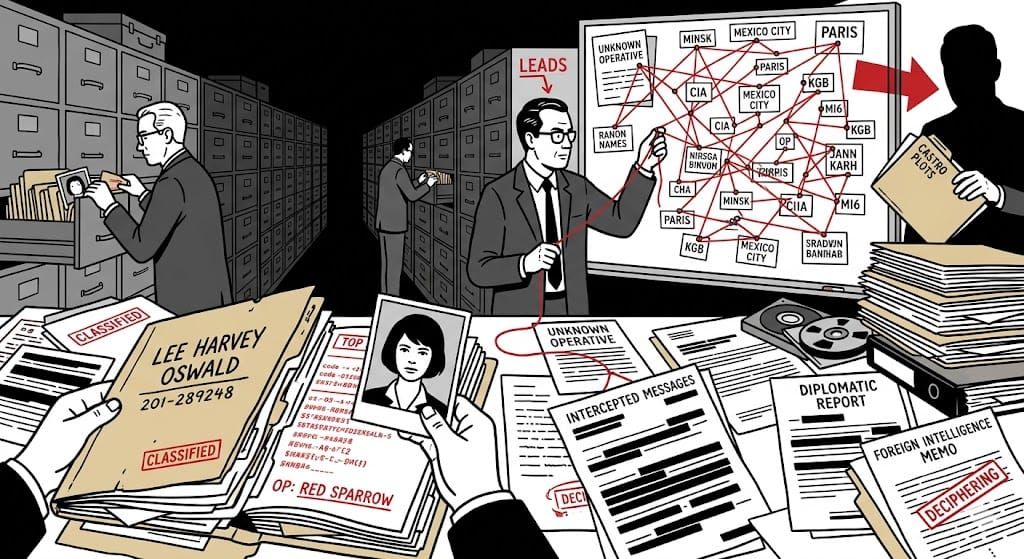
On the Mexico City photographs, Hoch documents that in October 1963 the CIA obtained photographs from what was described as Mexican police surveillance cameras at the Soviet Embassy, showing a still-unidentified Embassy visitor who does not physically resemble Oswald. This man was identified as Oswald in a CIA telegram to the FBI before the assassination. Hoch notes the CIA's explanation for this misidentification was not released by the Commission, and may be in withheld documents at the National Archives. The identified man may have been an associate of Oswald or an impostor.
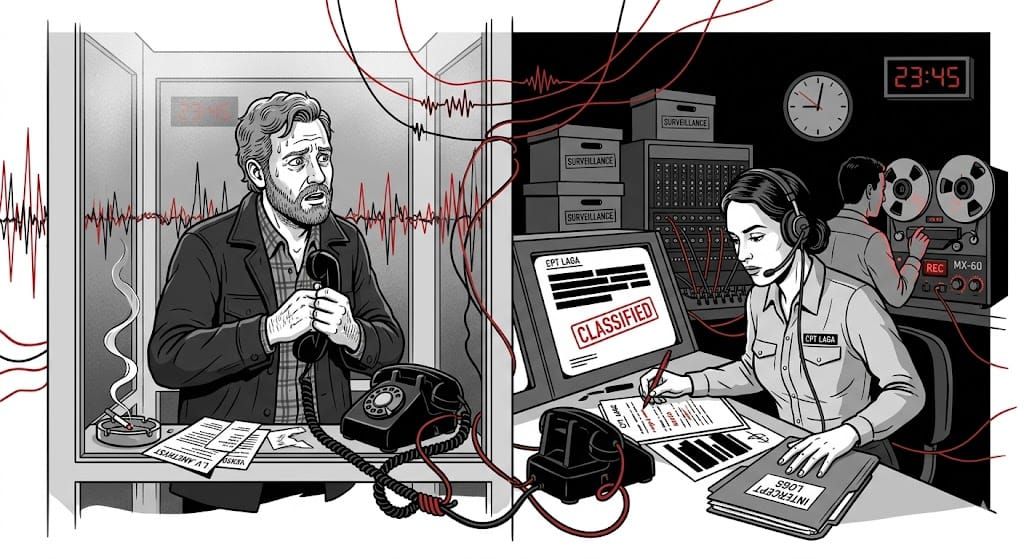
On intercepted conversations in Mexico City, Hoch states that an FBI report on Oswald in Mexico strongly suggests the CIA intercepted at least two phone calls between the Cuban and Russian Embassies in which Oswald was discussed, and that during one call Oswald was apparently on the phone himself. The CIA also had detailed knowledge of Oswald's conversation with a Soviet Embassy guard, including the fact that Oswald spoke broken Russian. Hoch states the CIA declined to tell him whether any recorded conversations exist or to release relevant records.
On E. Howard Hunt and Mexico City, Hoch notes that Hunt was reported to be the CIA's acting station chief in Mexico City during August and September 1963, a period overlapping with Oswald's visit. Hunt reportedly denied to the Rockefeller Commission that he met Oswald. Hoch calls for a determination of whether Hunt had any knowledge of Oswald's activities in Mexico, with reference to contemporaneous CIA station communications.
The handling of the Story of D receives detailed attention. Gilberto Alvarado Ugarte, a Nicaraguan who said he was on a penetration mission for the Nicaraguan Secret Service, claimed he witnessed Oswald receiving money at the Cuban Embassy in Mexico City to kill Kennedy. He later retracted the story, saying he made it up to provoke U.S. action against Castro, then withdrew the retraction, then failed a lie detector test, then said the lie detector must be wrong. Hoch observes that this pattern of retraction suggests Alvarado had told the story as an agent who later did not know whose orders to follow. CIA communications about Alvarado went to the White House, the FBI, the State Department, and the Secret Service. Hoch argues the story's apparent effect was to impress President Johnson with the threat that Castro was behind the assassination, and thus to deter both Johnson and the Warren Commission from exploring that alternative to the lone-assassin hypothesis. He states plainly that the Warren Report concluded Alvarado was lying but did not explore the possible implications of a planted false story.
On James Angleton, Hoch documents that at the time of his resignation as head of the CIA's Counterintelligence Division, Angleton was quoted as saying to journalist Seymour Hersh: 'A mansion has many rooms and there were many things going on during the period of the anti-war bombings. I'm not privy to who struck John.' Hoch notes it is conceivable that 'Who Struck John' was a code name for a CIA study of the Kennedy assassination, and that an intended reference to John Kennedy seems as likely as any other explanation for the remark. He calls for Angleton to be asked to explain the statement and whether he is aware of any CIA investigations of the assassination that reached conclusions different from the Warren Commission's.
On CIA activities related to critics of the Warren Report, Hoch raises the possibility that CIA coverage of researchers and journalists may have included the dissemination of false reports to draw attention away from serious questions involving the agency. He documents that the CIA gave the Warren Commission a 1937 Gestapo memo on Joachim Joesten, the author of one of the first critical books on the assassination, and that information from that memo on Joesten's alleged Communist Party membership was later introduced into the Congressional Record in a report allegedly written by the CIA, claiming his criticism was part of a Communist defamation campaign. Hoch calls for the agency to be asked whether it intercepted the mail of or otherwise interfered with critics of the Warren Report in the United States or abroad.
Part Three: The CIA's Own Investigation of the Assassination
Hoch documents that the CIA was given access to a remarkable amount of investigative material during the Warren Commission period, far beyond what its formal cooperation role would suggest. The FBI forwarded to the CIA all major investigative reports from the Dallas office. The Secret Service was asked to send the CIA a number of its reports, including all interviews of Marina Oswald. On at least one occasion during the Commission's work, the CIA actively suggested further investigation, with an agency memo recommending it was of considerable importance to investigate the report that Oswald had attempted suicide in Russia and that if necessary his body should be exhumed to verify a scar on his wrist.
Hoch notes that the CIA's interest in the assassination continued well after the Warren Commission finished its work. More than two months after the Warren Report was published, the CIA asked for a copy of the Zapruder film, reportedly for training purposes, which Hoch assumes means training for photo analysts. He notes that the Warren Commission's study of the Zapruder film was superficial, and that the report failed to mention or explain the fact that Kennedy was driven forcefully backwards by the fatal shot, which the Commission attributed to a shot from behind. Hoch cites an experiment he helped another investigator perform that confirmed the backward movement of Kennedy's head was consistent with the bullet's trajectory as described in the Warren Report, but notes the CIA should be asked to reveal what conclusions it reached from its own analysis of the film.
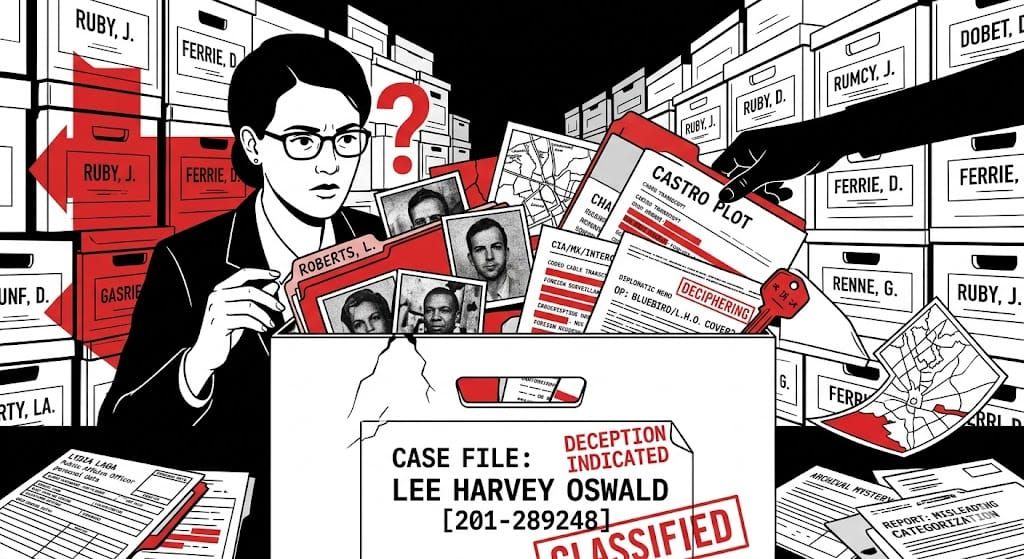
On CIA Director McCone and Deputy Director Helms's testimony that all relevant pre-assassination information had been supplied to the Commission, Hoch documents that a Commission staff member visited CIA headquarters and saw a computerized printout on Oswald that he described as including no document which the Commission had not been given in full or in paraphrase. Hoch then notes that the CIA should be asked to list all records not in the official dossier CD 692 that mention Oswald, specifically including records filed under his middle name Henry, since some records used that variant.
Part Four: The CIA, Anti-Castro Operations, and the Possible Link to the Assassination
This is the most analytically ambitious section of the memo and the one most directly relevant to the broader JFK conspiracy question. Hoch argues there is a factual basis for a serious inquiry into the connection between the Kennedy assassination and CIA anti-Castro activities, built on three established facts: the CIA tried to kill Castro working through the Mafia; E. Howard Hunt had apparently sensitive knowledge about the Bay of Pigs operation that led Nixon to obstruct justice over Watergate; and there is a definite documented link between a man representing himself as Leon Oswald and one of the CIA's assassination attempts against Castro.
The Sylvia Odio incident gets the most thorough treatment in this section. Sylvia Odio was a Cuban exile active in anti-Castro organizing in Dallas. She testified that approximately two months before the assassination, three men visited her home. One was introduced as Leon Oswald, described as an American ex-Marine who was great and kind of nuts and who thought Kennedy should have been shot after the Bay of Pigs because he was the one who was holding the freedom of Cuba. The men said they were friends of Odio's father, who was imprisoned in Cuba, and said Leon Oswald could do anything, like getting underground in Cuba, like killing Castro.
Hoch notes that the Commission staff recognized the Odio incident as potentially the most significant witness account in the entire investigation. Commission staff member David Slawson called Odio the most significant witness linking Oswald to anti-Castro Cubans. Assistant Counsel Burt Griffin wrote that the most reasonable situations under which Oswald might have had conspirators derive from his efforts to infiltrate the anti-Castro Cubans and to obtain a visa to Cuba, and recommended the Warren Report should explore at length the allegations made by Sylvia Odio. Just ten days before the Warren Report came out, Commission lawyer Wesley Liebeler wrote that Odio may well be right and that the Commission will look bad if it turns out she is. The Commission's response, Hoch documents, was a last-minute identification of three anti-Castro activists as the probable visitors, which later interviews then invalidated.
The connection Hoch establishes between Sylvia Odio and CIA anti-Castro operations is the analytical centerpiece of this section. Odio's father was imprisoned in Cuba because of his involvement in an attempt to kill Fidel Castro. The Odios had harbored one of the assassins after the failed attempt. Because this assassination attempt occurred reasonably close in time to the Bay of Pigs, Hoch argues it is reasonable to suspect that the CIA was directly involved in it. In any case, he states, the CIA must have learned the details of the plot. He argues the degree of CIA sponsorship or knowledge of the attempt that led to the arrest of Odio's father must be determined.
The Alvarado Story of D is revisited here in connection with the anti-Castro operation framework. Hoch argues that the story's apparent purpose was to create pressure on President Johnson and the Warren Commission to avoid investigating the links between CIA anti-Castro operations and the assassination. He notes that President Johnson was known to believe the assassination was a retaliatory act by Cuban Communists, and that this belief was reinforced by the CIA-originated Alvarado story. The effect of the story, Hoch argues, whether intended or not, was to make any alternative to the lone-assassin conclusion seem to implicate Cuba and thus to trigger an international crisis.
On E. Howard Hunt and assassination attempts against Castro, Hoch documents that Hunt chose in his own book to bring up the matter of assassination attempts against Castro, saying he had recommended Castro be killed before or at the time of the Bay of Pigs invasion and that his recommendation was 'in the hands of a special group.' Hunt then wrote that he could find no coherent plan developed within the CIA to assassinate Castro, though it was the heart's desire of many exile groups. Hoch calls this choosing words to conceal or hint at what he knew rather than to reveal it.
The Nixon-Watergate-Bay of Pigs connection receives specific treatment. Hoch documents that on June 23, 1972, Nixon told Haldeman to have the CIA cut off the FBI investigation into Watergate on the grounds that it might open up the whole Bay of Pigs thing. Hoch argues it is quite plausible that this phrase was a euphemism for CIA assassination attempts against Castro that had grown out of the Bay of Pigs operation, and notes that it seems essential to determine what Nixon, Haldeman, Helms, and the FBI understood the phrase to mean.
On Robert Kennedy and the Castro plots, Hoch documents the Jack Anderson columns of 1967 and 1971 reporting that Robert Kennedy had authorized CIA-Mafia plots against Castro that may have backfired against his brother. He notes that Robert Kennedy was reportedly outraged by the 1967 Anderson column and told two aides that he had stopped, not started, the plot against Castro. Hoch also notes the FBI told President Johnson that Cuban leaders had hoped for Kennedy's death, and documents Robert Kennedy's reportedly morose behavior after the assassination as possibly reflecting the terrible thought that he had helped put into motion forces that indirectly may have brought about his brother's death.
The Postscript: The Warren Commission Memo That Should Have Changed Everything
The final section of Hoch's memo is a postscript containing material he received from the National Archives after the main memo was written: a formerly withheld internal Warren Commission memo written by William Coleman and David Slawson, the Commission's two lawyers most responsible for investigating foreign involvement in the assassination. The memo was written at roughly the midpoint of the Commission's investigation to present the evidence pertaining to foreign involvement.
Coleman and Slawson's internal analysis, written in 1964 and kept from the public for years, set out in plain terms how an anti-Castro Cuban conspiracy to kill Kennedy could have worked. Their memo stated that Oswald could have become known to the anti-Castro Cubans as strongly pro-Castro, and that the anti-Castro Cuban group may have believed the fiction Oswald tried to create that he had organized some sort of large active Fair Play for Cuba group in New Orleans. It noted that someone in the anti-Castro organization might have been keen enough to sense that Oswald had a penchant for violence that might easily be aroused, citing the fact that he laughed at the Cubans and told them it would be easy to kill Kennedy after the Bay of Pigs.
Coleman and Slawson wrote that some sort of deception was used to encourage Oswald to kill the President when he came to Dallas, and that perhaps double agents were even used to persuade Oswald that pro-Castro Cubans would help in the assassination or in the get-away afterwards. They argued the motive would be the expectation that after the President was killed Oswald would be caught or at least his identity ascertained, and the public would then blame the assassination on the Castro government, making the call for its forceful overthrow irresistable. A second Bay of Pigs invasion would begin, this time, hopefully, to end successfully.
The Commission's working staff wrote a memo in 1964 describing a sophisticated anti-Castro Cuban conspiracy in which Oswald was used as a patsy to trigger a second Bay of Pigs invasion. That memo was withheld from the public. The Warren Report's final conclusions did not reflect this analysis. Hoch writes that facts known now but not known to Coleman and Slawson in 1964 make additional investigation even more necessary.
How It Fits the Bigger Picture
Record 104-10196-10027 occupies a unique position in the JFK assassination record because it is not itself a government document. It is an independent researcher's analytical work product that the CIA chose to file and retain. Read alongside the NSA documents examined in previous entries in this series, it illuminates the same institutional problems from a different angle.
The NSA records showed an agency conducting its post-assassination reviews informally, reporting results verbally, destroying copies, and leaving the investigators who conducted the work to retire before they could be questioned. The Hoch memo shows what a careful outside analyst could see in the public record by 1975: that the CIA misled the FBI on the day of the assassination about the extent of its Oswald file, that the Warren Commission was denied access to material on Marina Oswald and on Oswald's Mexico City activities, that the Commission's own staff recognized the Odio incident as potentially reflecting a conspiracy and then failed to adequately investigate it, and that Allen Dulles, sitting as a Warren Commission member, told his colleagues in secret session that the CIA would not tell the truth about informant relationships even under oath.
The handwritten annotations in the CIA reader's copy of this memo are worth noting as a category of evidence in themselves. Someone inside the CIA read this memo carefully, underlined passages, circled names, and added marginal notes. The annotations show the agency was tracking which of Hoch's claims touched on sensitive areas. That is not the behavior of an institution confident that a researcher's inquiry into its files would find nothing of concern.
Three years after Hoch wrote this memo, the HSCA began its work. The committee investigated many of the same threads Hoch identified: the Odio incident, the 544 Camp Street connection, E. Howard Hunt's knowledge of Castro assassination plots, the CIA's incomplete disclosure to the Warren Commission, and the anti-Castro exile network's potential connections to the assassination. The HSCA concluded in 1979 that Kennedy was probably assassinated as a result of a conspiracy, while stopping short of identifying the conspirators. The Coleman and Slawson memo, surfaced in Hoch's postscript, shows that the Commission's own lawyers had sketched the most plausible version of that conspiracy eleven years earlier and then watched it disappear from the final report.
The Bottom Line
Record 104-10196-10027 is the most analytically comprehensive document in this series so far, and one of the most important items in the entire JFK assassination record for a specific reason: it was written by an outsider with no institutional stake in the outcome, based entirely on public documents and Freedom of Information Act materials available by March 1975, and it identified with greater precision and rigor than any government inquiry had yet achieved the specific questions that needed to be answered about the CIA's relationship with Lee Harvey Oswald.
Hoch's central argument, stated quietly and backed by ninety footnotes, is that the Warren Commission's investigation was compromised not by simple incompetence but by the deliberate management of information by the CIA and FBI. Allen Dulles told the Commission in secret that the CIA would not tell the truth about informants under oath, then sat as a Commission member reviewing the CIA's denial that Oswald was an informant. The CIA made a false statement to the FBI on the day of the assassination about the extent of its Oswald file. The FBI suppressed the 544 Camp Street connection to Guy Banister and never provided the relevant files to the Commission. The Commission's own lawyers wrote a memo describing a plausible anti-Castro Cuban conspiracy in which Oswald was used as a patsy, and that memo was withheld from the public while the final report concluded Oswald acted alone.
The CIA kept a copy of this memo in its own files for over twenty years before releasing it. The marginal annotations show it was read carefully inside the agency. What the reader thought of what they found there remains, like so much else in this record, unrecorded.
Subscribe to our newsletter
Subscribe to our newsletter to get the latest updates and news






Member discussion