



members only
The Rise and Decline of the Publishing Empire
For most of the twentieth century, traditional publishing operated with the quiet confidence of an industry that believed in its own permanence. The major publishing houses sat at the center of the literary world, deciding which books would be written, which authors would be paid, and which ideas would reach the reading public. That arrangement seemed, to those who benefited from it, like the natural order of things. It was not. It was a business model built on specific historical conditions, and when those conditions began to change, the empire built upon them began to crack.
This is the story of how traditional publishing rose to dominance, what sustained it for so long, and why the ground beneath it is shifting in ways that publishers are still struggling to fully absorb.
The Foundations: How Traditional Publishing Built Its Empire
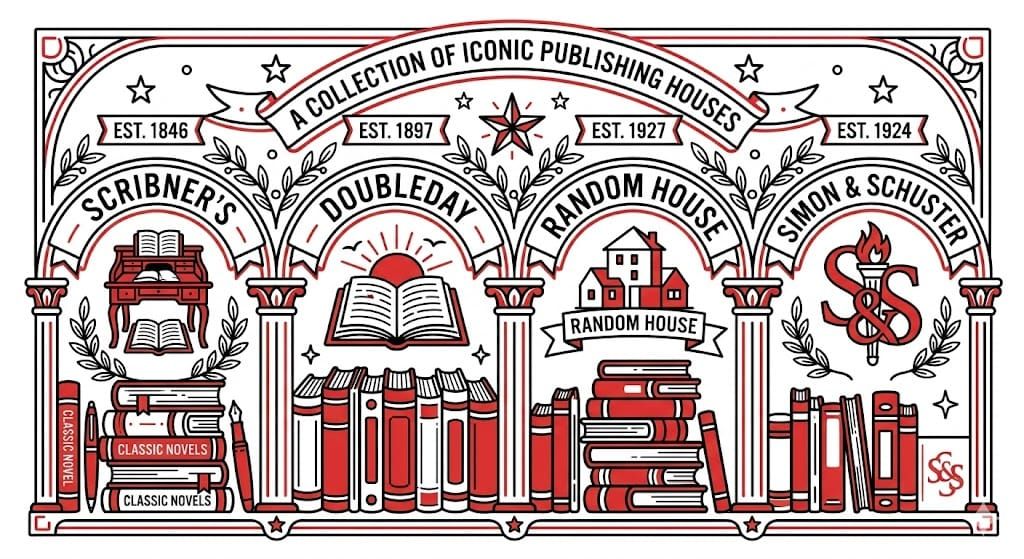
To understand the publishing industry as it exists today, it helps to understand where it came from. Modern American publishing took shape in the late nineteenth and early twentieth centuries, when a cluster of houses based primarily in New York City established themselves as the primary conduit between writers and readers. Houses like and more options for engaging built their reputations by identifying literary talent, investing in the production and distribution of books, and cultivating relationships with booksellers, reviewers, and readers across the country.
What made this model viable was the absence of any real alternative. Before the digital age, publishing a book required physical infrastructure: printing presses, paper, binding equipment, warehousing, and a distribution network capable of moving physical objects to retail locations across a vast geography. These were not capabilities that an individual author or a small operation could easily replicate. The publishing house controlled the infrastructure, and the infrastructure was the bottleneck. If you wanted your book in front of readers, you needed a publisher.
This structural reality gave publishers enormous leverage. They could be selective, and they were. The submission and rejection process that writers still navigate today was born in this era, not as a neutral quality filter but as a practical consequence of scarcity. Publishers had limited capacity to produce and distribute books, so they made choices about which books were worth that investment. Over time, those choices became codified into taste, into aesthetic standards, into a set of assumptions about what literature was supposed to look like and do.
The literary agent emerged from this same period as an intermediary between authors and publishers, a figure who understood the industry's commercial logic and could negotiate on behalf of writers who typically did not. The agent's role was, and remains, fundamentally shaped by the power imbalance between individual authors and institutional publishers. Authors needed agents because they needed advocates within a system that was not designed with their interests as the primary concern.
The Golden Age and Its Gatekeepers
Through the mid-twentieth century, traditional publishing enjoyed what many in the industry still look back on as a golden age. Publishers invested in authors over long careers, nurturing writers through multiple books, even when early work did not sell spectacularly. Editors were figures of genuine cultural authority, shaping manuscripts in deep collaboration with authors. The relationship between publisher and writer, at its best, was genuinely creative.
But even in this golden age, the gatekeeping function of publishing came at a high cost. The authors who benefited from the system's generosity were disproportionately white, disproportionately educated, and disproportionately connected to the social networks that fed into publishing houses. Writers who existed outside those networks, whether by geography, race, class, or the nature of what they were writing, found the gates considerably harder to open.
This is not a minor footnote. It is central to understanding what traditional publishing actually was, as opposed to what its mythology suggests it was. The prestige and authority of the major houses rested on a set of curatorial choices that reflected the limitations and biases of the people making them. Some genuinely great literature passed through those gates. A great deal of genuinely great literature did not.
Consolidation and the Rise of the Big Five
The publishing landscape that most authors encounter today is the product of several decades of aggressive consolidation. Beginning in the 1980s and accelerating through the 1990s and 2000s, the fragmented ecosystem of independent publishers was gradually absorbed into a small number of large conglomerates. Today, the industry is dominated by five major houses: Penguin Random House, HarperCollins, Simon and Schuster, Hachette Book Group, and Macmillan Publishers. These are commonly referred to as the Big Five.
This consolidation changed the industry in ways that are still being fully reckoned with. On one hand, the major conglomerates brought resources and reach that smaller independent houses could not match. On the other hand, consolidation meant that publishing decisions were increasingly made within a corporate framework oriented toward profitability and risk management rather than editorial vision. The long-term investment in authors that characterized the mid-century golden age became harder to sustain when quarterly earnings reports and shareholder expectations entered the picture.
One of the most significant consequences of consolidation was the bifurcation of the advances market. The Big Five began concentrating large advances on a relatively small number of high-profile titles, often by celebrities, established authors, or authors whose books could be positioned as certain commercial successes. Midlist authors, those writing serious, quality fiction and nonfiction without the marketing profile of a household name, found their advances shrinking and their publishers' promotional investment declining. Many found themselves dropped after one or two books that sold respectably but not spectacularly.
This created a quiet crisis in the middle of the publishing industry. The midlist had historically been the engine of literary culture, the space where writers developed their craft across multiple books and built readerships over time. As that space contracted, authors who might once have expected a sustainable career within traditional publishing found themselves squeezed out.
The Digital Disruption
The forces that began seriously destabilizing traditional publishing arrived in the late 1990s and accelerated dramatically in the following decade. They came from two directions simultaneously: the internet and Amazon.
Amazon launched as an online bookseller in 1995 and quickly demonstrated that it could undercut traditional booksellers on price, selection, and convenience in ways that brick-and-mortar stores simply could not match. The rise of Amazon contributed directly to the collapse of many independent bookstores and the eventual bankruptcy of Borders, one of the two major chain bookstore operations in the United States. Barnes and Noble survived, but in a significantly diminished form.
This shift in retail power had profound consequences for publishers. Amazon was not simply a more efficient version of a traditional bookstore. It was a technology company with ambitions that extended well beyond bookselling, and it had both the leverage and the willingness to use it. Publishers found themselves negotiating with a retail partner that controlled an ever-larger share of their sales and that was willing to engage in extended, bruising contract disputes when its terms were not met.
The introduction of the Kindle in 2007 accelerated the disruption by creating a viable mass market for digital books. E-books had existed before the Kindle, but Amazon's device and its associated ecosystem made digital reading genuinely convenient for ordinary consumers. E-book sales grew rapidly through the late 2000s and early 2010s, and with them came a question that the publishing industry was not prepared to answer cleanly: what is a book actually worth in a digital environment where the physical costs of production and distribution are dramatically reduced?
Publishers initially priced e-books high, attempting to protect their print sales and their existing pricing structures. Amazon pushed for lower prices, recognizing that cheaper e-books would sell more Kindles and generate more revenue from its ecosystem overall. The resulting conflict led to the agency pricing dispute of 2010, in which Apple and several major publishers attempted to coordinate a pricing strategy that would allow publishers to set their own e-book prices. The Department of Justice investigated, found evidence of price-fixing, and several publishers settled. The episode left publishers weakened and Amazon's dominance in the e-book market further entrenched.
The Self-Publishing Revolution and What It Revealed
The same digital infrastructure that disrupted traditional publishing also, for the first time, gave individual authors a genuine alternative to it. Amazon's Kindle Direct Publishing platform, launched in 2007, allowed authors to publish e-books directly to Amazon's marketplace without a publisher, agent, or any of the traditional gatekeepers. Print-on-demand technology extended this capability to physical books. Suddenly, the infrastructure bottleneck that had given publishers their structural power for more than a century was gone.
The early years of self-publishing's resurgence were chaotic and produced a great deal of work that validated every skeptical thing traditional publishing had ever said about quality control. But they also produced something the skeptics had not anticipated: a cohort of authors who built substantial readerships and generated significant income entirely outside the traditional system. Romance, thriller, science fiction, and fantasy authors in particular found that genre readers were willing to discover and support self-published work in large numbers, especially at the lower price points that self-publishing made possible.
More broadly, the self-publishing revolution revealed something important about the traditional publishing model: a great deal of its authority had rested on scarcity that no longer existed. The gates had been powerful because there was no way around them. Once a way around them appeared, authors began asking whether the gatekeepers' judgment had always been as reliable as the industry's mythology suggested. Many concluded that it had not.
Where Traditional Publishing Stands Today
Traditional publishing has not collapsed, and it is unlikely to disappear. The major houses retain genuine advantages: editorial expertise, relationships with major retailers, the capacity to generate mainstream media coverage, and the cultural authority that still attaches to a book bearing a prestigious imprint. For certain kinds of books, in certain kinds of markets, a traditional publishing deal remains the most effective path to wide readership.
But the industry is under real pressure, and the pressure is not abating. Advances for midlist authors remain depressed. Royalty rates, particularly for e-books, remain a source of ongoing conflict between authors and publishers, with many authors receiving royalties of 25 percent of net receipts on digital sales while self-published authors on Amazon receive 70 percent of the list price. The Authors Guild and other author advocacy organizations have documented a long-term decline in author incomes even as the overall book market has grown.
Meanwhile, the self-publishing market continues to mature. The stigma that once attached automatically to self-published work has eroded considerably, particularly in genres where self-published authors have demonstrated commercial success at scale. Hybrid authors, those who publish some work traditionally and some independently, have become increasingly common as writers seek to capture the advantages of both models.
The result is an industry in genuine transition, one where the old hierarchies are less stable than they once were, where the paths to readership have multiplied, and where the definitions of success are being actively renegotiated by authors who are no longer willing to accept the traditional publishing industry's terms as the only terms available.
What This Means for Writers Navigating the Landscape Today
For any writer trying to build a career in this environment, the history matters because it shapes the present. The prestige of traditional publishing is real, but it is also a legacy of a structural advantage that no longer fully exists. The condescension sometimes directed at self-published authors is a remnant of a gatekeeping culture that served institutional interests as much as it served readers or literary quality.
At the same time, the challenges of self-publishing are real and should not be minimized. Distribution, discoverability, editorial quality control, and the sheer volume of competition in self-published marketplaces are genuine obstacles that traditional publishing's infrastructure, whatever its other limitations, does address.
The honest picture is one of genuine complexity. Neither traditional publishing nor self-publishing offers a clear, uncomplicated path to success. Both involve navigating systems with structural inequities, conflicting incentives, and imperfect measures of merit. What has changed is that authors now have more information about both systems than they once did and more options for engaging with them.
Understanding that history is not a reason for cynicism. It is a prerequisite for making clear-eyed decisions about your own work and your own career. The empire of traditional publishing is not what it once was. What replaces it is still being built, and writers who understand the terrain are better positioned to help shape what that replacement looks like.
Subscribe to our newsletter
Subscribe to our newsletter to get the latest updates and news





Member discussion