
Why the JFK Archive Is Buried in Documents That Say Nothing

Record No.: 104-10433-10187
Agency: CIA
Originator: CIA
This series has now worked through four consecutive documents with no meaningful connection to the Kennedy assassination. A Cuban exile's immigration file. A handwritten index card pointing to a box stored elsewhere. A twenty-year career summary of a CIA asset in West Africa. A five-line list of NSA serial numbers generated in response to a researcher's FOIA request. All four were in the JFK assassination records collection. All four were classified. All four took years or decades to release. None of them tell us anything about who killed the President.
That pattern deserves an explanation, because it is not an accident.
How the Collection Was Built
The JFK Records Collection at the National Archives exists because of the President John F. Kennedy Assassination Records Collection Act of 1992, passed by Congress in the wake of Oliver Stone's film JFK, which renewed public pressure for full disclosure of government records related to the assassination. The law created the Assassination Records Review Board, an independent body with the power to identify, review, and order the release of assassination-related records held by any government agency.
The critical word in that mandate is identify. The ARRB did not simply ask agencies to turn over their Kennedy assassination files. It reviewed the agencies' own filing systems and made determinations about which records fell within the scope of the law. For the CIA, that meant examining entire file series, not individual documents. If a file series contained records relevant to the assassination, the entire series came under review, including everything else filed in that series for entirely unrelated reasons.
This is how an asset debriefing about West Africa ends up in the same collection as the Mexico City intercept transcripts. Both were stored in CIA administrative file series that the ARRB determined fell within its mandate. The law required disclosure of assassination records. The agencies complied with the letter of that requirement by releasing entire file series, which contained assassination records alongside decades of unrelated operational and administrative material.
The Volume Problem
The JFK assassination records collection currently contains approximately five million pages of documents across roughly 320 collections. The CIA alone contributed more than 1,100 collections. The FBI contributed records running into the hundreds of thousands of pages. The NSA, the State Department, the Defense Department, and dozens of other agencies added their own holdings.
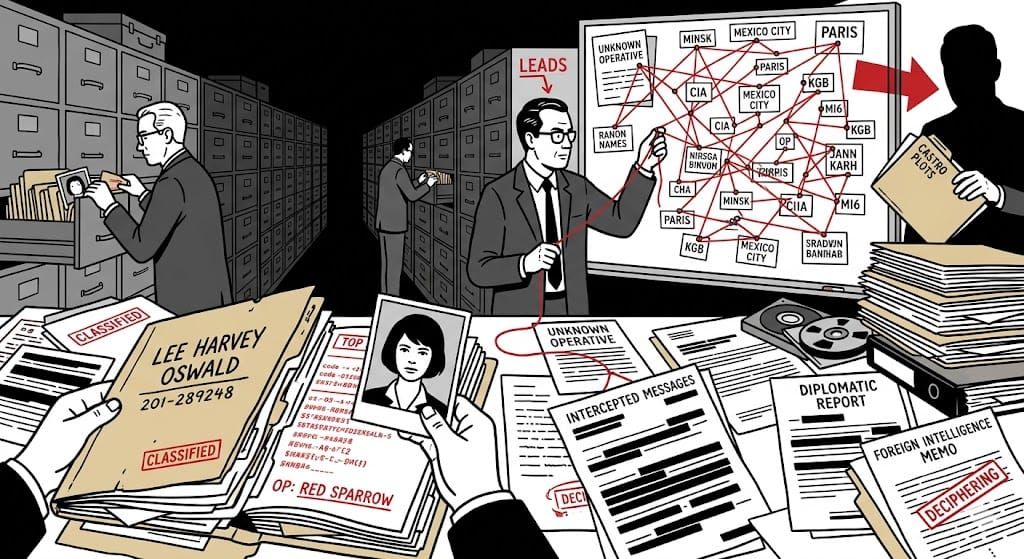
Navigating five million pages without institutional support, without a full finding aid, and without the ability to search document content rather than just metadata is not a research task. It is an endurance test. A determined independent researcher working full time, reading one hundred pages per day, would need approximately 137 years to read the collection cover to cover. The practical effect of releasing five million pages is that almost none of it gets read by almost anyone.
This is not a theoretical concern. It is the documented experience of every serious researcher who has worked in this collection. Harold Weisberg, whose name appears on the very document that prompted this essay, spent decades filing FOIA requests and fighting the CIA and FBI in court for individual documents while the agencies buried relevant records in seas of administrative paper. Weisberg was not a fringe figure. He was a meticulous researcher who identified specific documents he needed and spent years proving in court that agencies had lied about their existence. The document in this entry is literally a CIA list of NSA records generated in response to one of his FOIA requests. He never got the underlying documents.
The NBR Mechanism
The Assassination Records Review Board created the Not Believed Relevant designation specifically to handle documents that ended up in the review process but had no connection to the assassination. The ARRB could declare a document NBR and still require its release, or it could allow the document to remain postponed. In practice, NBR documents were often released eventually, sometimes years after the review, as part of bulk releases triggered by the JFK Records Act's deadlines.
The NBR designation is evidence of the collection's internal honesty about its own noise-to-signal ratio. The ARRB itself was acknowledging, record by record, that the collection contained large volumes of material unrelated to its stated purpose. The Roberts debriefing from the previous entry was declared NBR in April 1994. The Weisberg FOIA serial number list in this entry was declared NBR in December 1998. Both were still released as part of the collection. The collection contains thousands of NBR documents.
There is a reasonable argument that releasing NBR documents alongside substantive ones serves an important function: it demonstrates that the release was genuinely comprehensive rather than selectively curated. An agency that releases only the records it wants you to see is not making a disclosure. Releasing everything, including the file cards and the routing slips, provides a paper trail that researchers can use to identify what is missing. If a file series contains one hundred documents and only ninety are released, the ten gaps are visible. That visibility matters.
The counterargument is equally reasonable. Releasing five million pages when perhaps fifty thousand pages contain substantive information is a form of concealment by volume. You are not hiding the needle. You are burying it in a haystack large enough that finding it requires resources most people do not have.
What Discouragement Looks Like in Practice
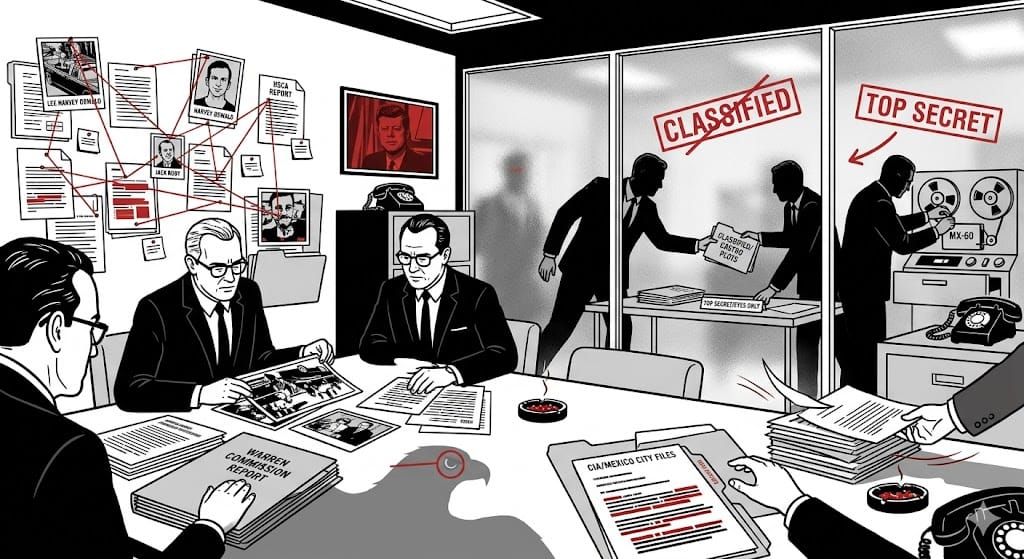
The effects of volume-based concealment are not hypothetical. They are measurable in the history of JFK assassination research. The Warren Commission's twenty-six volumes of hearings and exhibits were released in 1964. They ran to approximately ten million words. The stated purpose was transparency. The practical effect was that almost no journalist, legislator, or member of the public read them in full. The critics who did, researchers like Sylvia Meagher, Harold Weisberg, and Mark Lane, spent years doing what should have been done by the Commission's own investigators and by the press.
When the HSCA released its twelve volumes in 1979, the same pattern repeated. When the ARRB releases began in the 1990s and continued through 2017 and 2018, the same pattern repeated again at a larger scale. Each release cycle generates a brief period of media attention, a wave of claims based on partial reading, and then a gradual subsidence as the volume of the material defeats the attention of everyone except the most dedicated specialists.
The agencies responsible for producing these records understand this dynamic. They have decades of experience watching it play out. The question of whether the volume of administrative noise in the JFK collection reflects deliberate strategy or simply the normal output of large bureaucracies that kept records on everything is genuinely difficult to answer from the outside. Both explanations are consistent with the evidence. Bureaucracies do keep records on everything. Agencies do also know that releasing everything means most of it never gets read.
What This Series Is For
Reading the Record began with a simple premise: read each document, explain what it actually says, and place it accurately in the context of the larger investigation. That premise is harder to execute than it soundsbecause the collection does not distinguish between a document that changes your understanding of the assassination and one that was filed in the wrong folder in 1964 and never touched again.
The four documents covered in the past four entries are, in their way, as important to understand as the Mexico City intercepts or the Hoch research memo. Not because of what they contain, but because of what their presence in the collection tells us about how the release was structured. The Rodriguez Molina immigration file, the bulky file index card, the Roberts CIA debriefing, and the Weisberg FOIA serial number list are all filler. They are also all real. They are what you encounter when you read these files the way this series reads them: document by document, without skipping anything.
Understanding that the collection is built this way changes how you read everything in it. Every document that does contain something significant was found by someone who read past hundreds of documents that did not. That labor is invisible in the history of what we know about the Kennedy assassination. This series is, among other things, an attempt to make it visible.
The Document That Prompted This Essay
For the record: DocID 32397504 is a three-page SECRET document from the Russ Holmes Work Files, the working papers of a CIA officer who managed the agency's responses to Warren Commission and HSCA inquiries and researcher FOIA requests. The substantive page is a one-page list of five NSA SIGINT product serial numbers from 1967 and 1968, titled Identification List of Documents to Be Referred to NSA. The handwritten notation on the preceding blank page reads NSA Documents.
The five serial numbers listed are from the same QOF and QOY SIGINT series that appear in the NSA's own JFK-related documents examined earlier in this series, specifically the 1978 HSCA keyword search records. Someone in Holmes's office compiled this list in connection with Harold Weisberg's FOIA request for NSA materials related to the assassination. The underlying NSA documents those serial numbers point to are not in this release. Whether they were ever provided to Weisberg or to any other requester is not answered by this document.
It is a list of five serial numbers on a page. It was classified SECRET. It took over thirty years to release. It was declared Not Believed Relevant to the assassination. It is in the JFK records collection.
That is the archive in miniature.
The record doesn't keep itself. If you find value in this work, consider leaving a tip.
Subscribe to our newsletter
Subscribe to our newsletter to get the latest updates and news






Member discussion